en.Malanginspirasi.com – Twelve undergraduate and graduate students of participated in a summer course titled “Banyuwangi Coffee Learning Program: Field Study, Workshop, and Cultural Engagement from Farm to Cup,” organized by the Biology Department of the Faculty of Mathematics and Natural Sciences (FMIPA) University of Brawijaya (UB).
FMIPA UB collaborated with Universiti Teknologi MARA (UiTM) and Universiti Malaysia Sabah (UMS) for one week (April 7-15) in Malang and Banyuwangi.
Dr. Muhammad Yusuf S.Si., M.Si. (UB) with two accompanying lecturers, Mufidah Afiyanti S.P., Ph.D. (UB) and Dr. Umi Hartina Binti Mohamad Razali (UMS) coordinated this program.
All of those twelve international students stayed at a house in Kalipuro Village, Banyuwangi Regency, to learn about coffee farming, post-harvest management, traditional presentation and flavor, and interact with the farmers.
The program was the 5th Summer Course that Biology Department of FMIPA UB held.
Also Read:
UB Developed Hypothyroidism Early Detection Tool for Newborns
This year, the program spans ten days, with three days held online and seven days held at Brawijaya University and Banyuwangi Regency.
The ten-day program featured a variety of engaging activities, including coffee plantation visits, hands-on coffee bean processing, and cupping training, or tastings. Participants also receive materials from experienced coffee industry experts and practitioners.
“During this Banyuwangi event, participants interact extensively with local residents, enabling them to learn about the culture and various types of smallholder coffee in Banyuwangi, as well as gain new insights into traditional post-harvest management and unique flavors,” said Muhammad Yusuf.
Furthermore, students learned about environmentally friendly cultivation techniques and the challenges faced by farmers, such as climate change and market price fluctuations.
This summer course aims to enhance students’ knowledge in agriculture, rural studies, and natural resource management, particularly in addressing food security challenges in Southeast Asia.
The first day of activities in Banyuwangi covered coffee classification and coffee agroforestry flora diversity.
Students learned about the types and diversity of flora in coffee agroforests.
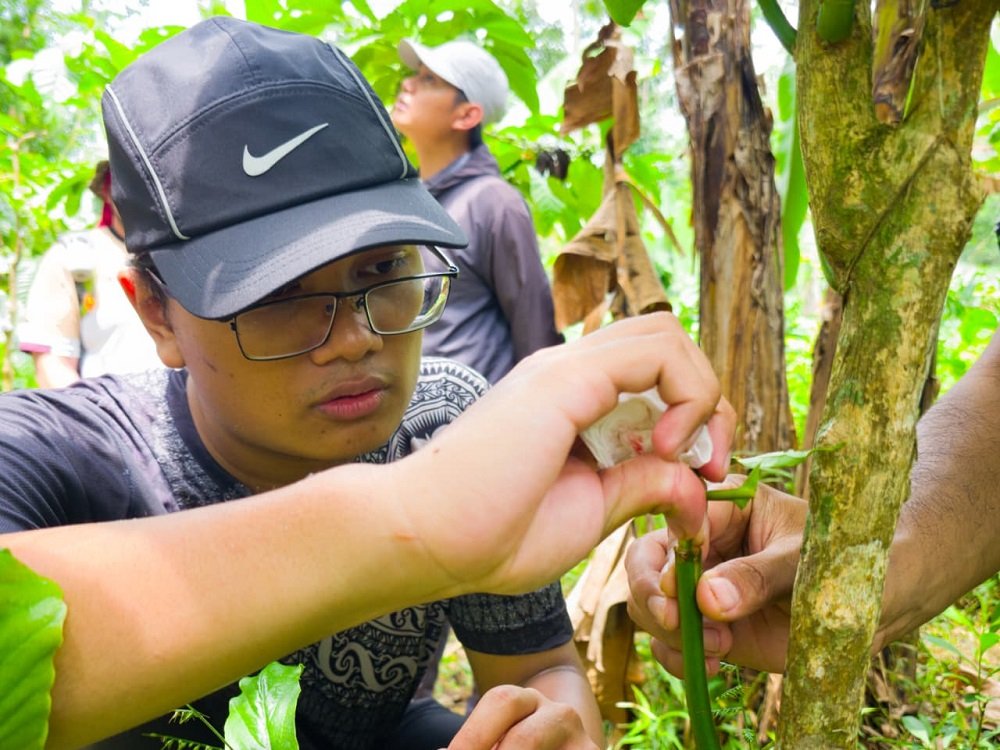
In the second session, “Coffee Planting Techniques and Increasing Coffee Productivity,” students interacted and communicated with local farmers, and experienced hands-on practice in grafting, pruning, and coffee picking.
“Kalipuro is one of the areas in Banyuwangi with rich biodiversity, particularly in coffee agroforestry. Furthermore, traditional management practices are still maintained by the community,” said Imron, a coffee farmer and founder of MEM Secang Kalipuro.
Enthusiasm of International Students
The international students were very enthusiastic about participating, answering a variety of questions and participating in hands-on practice, guided by local farmers.
“I enjoyed this activity; it was a fun, valuable experience. It was my first time in Banyuwangi. I was very open-minded and interested in developing and improving the quality of various coffee varieties,” said Muhammad A’rif Bin Mohd Ajib from MARA University of Technology.
This annual event opens up opportunities for collaboration between academics, industry players, and the community to develop the Indonesian coffee sector.
This activity also aligns with the Sustainable Development Goals (SDGs), specifically on quality education (SDG 4), decent work and economic growth (SDG 8), responsible consumption and production (SDG 12), climate change (SDG 13), and partnerships to achieve the goals (SDG 17) through capacity building for the younger generation and the implementation of sustainable practices in the coffee industry.