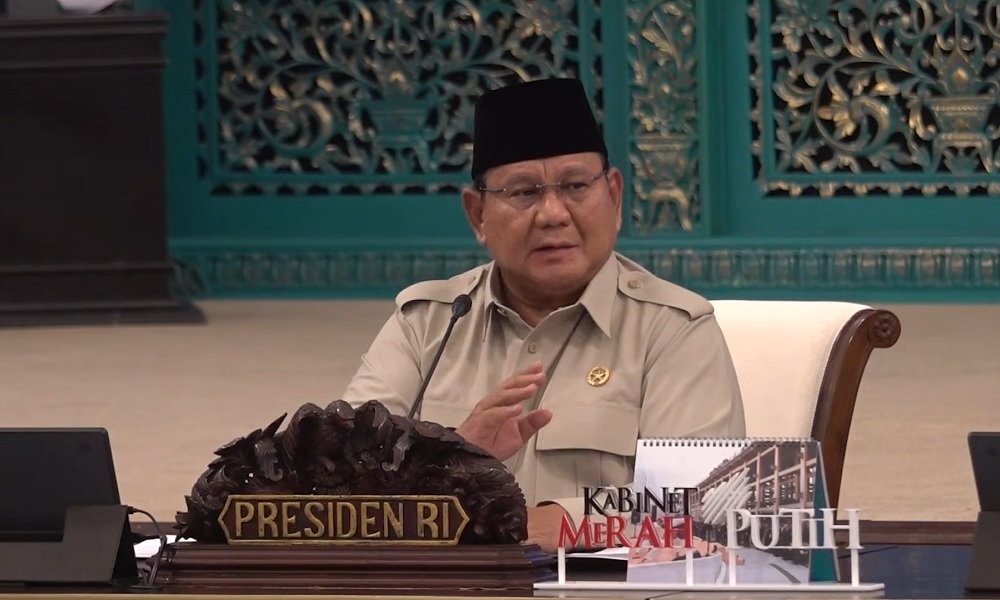
EN.malanginspirasi.com – President Prabowo Subianto has directed the Indonesian government to aggressively pursue work-from-home (WFH) arrangements for civil servants (ASN) and private-sector workers as a key strategy to reduce national fuel consumption amid escalating global energy prices triggered by conflicts in the Middle East.
Speaking during a plenary cabinet meeting at the State Palace on Friday (March 13, 2026), President Prabowo highlighted the urgent need for proactive fuel-saving measures to protect the state budget from volatility in international oil markets.
“We cannot assume we are safe just because supplies are stable now. We must take steps to reduce BBM consumption,” Prabowo stated, citing examples from countries like Pakistan that implemented WFH for up to 50% of government and private employees, alongside reducing workweeks to four days.
The president instructed relevant coordinating ministers—including those for the economy and administrative reform—to urgently evaluate options such as:
- Mandatory WFH for a significant portion (potentially 50%) of ASN and private workers.
- Hybrid schedules where ASN report to offices only three days per week (e.g., Monday, Wednesday, Friday), allowing two days of remote work.
- Broader four-day workweeks in select sectors.
Economists view the proposal as rational, noting that remote work during the COVID-19 pandemic proved effective in cutting fuel demand and traffic congestion. However, impacts would likely be more pronounced in the public sector than in diverse private industries.
Read Also:
Indonesia Chooses Selective Budget Cuts Over Fuel Price Hikes to Control 2026 Deficit
In a related but temporary measure, the government has already rolled out Work From Anywhere (WFA) for the Lebaran 1447 H / Eid al-Fitr 2026 period. Under Ministerial Regulation of PANRB No. 2/2026 and a corresponding circular from the Ministry of Manpower, flexible remote work applies on March 16–17 (pre-holiday) and March 25–27 (post-holiday return flows). The policy maintains full productivity, excludes essential services (health, transport, security), and does not deduct annual leave.
Jakarta Governor Pramono Anung has signaled readiness to align provincial ASN with the central directive, emphasizing support for both fuel savings and reduced metropolitan congestion.
As of March 19, 2026, no permanent weekly WFH quota (e.g., one fixed day per week) has been finalized. Discussions continue, with potential rollout in April 2026 or post-Lebaran if approved, balancing energy efficiency, public service continuity, and worker welfare.