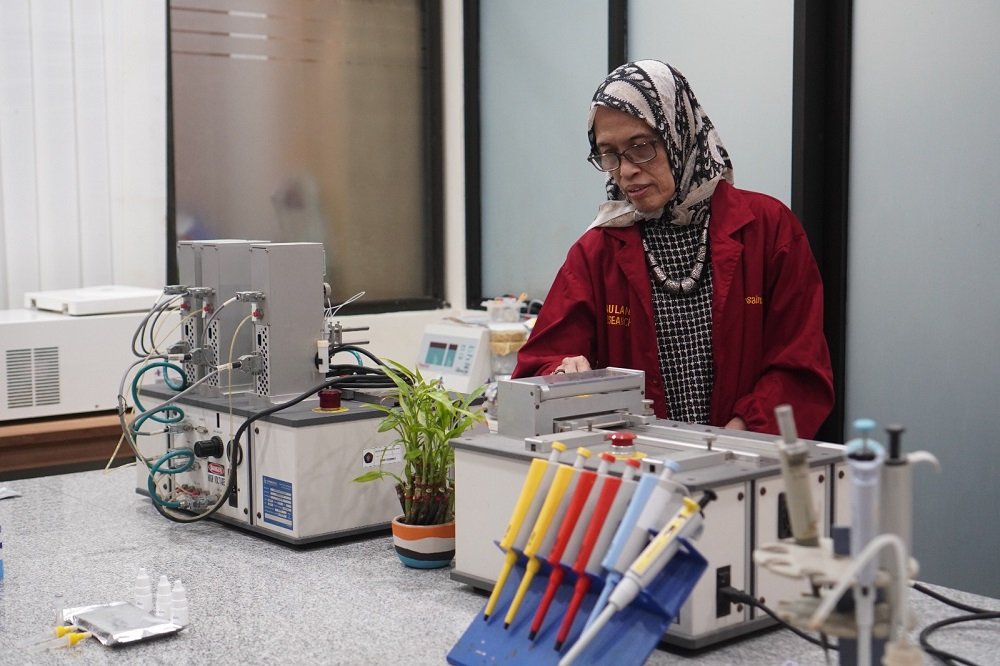
en.Malanginspirasi.com – A research team from Brawijaya University (UB), led by Prof. Dr. Aulanni’am, has developed a tool for early detection of hypothyroidism in newborns using the Enzyme-Linked Immunosorbent Assay (ELISA) method.
This innovation works as as a diagnostic system capable of increasing the accuracy, sensitivity, and efficiency of early detection of thyroid hormone disorders in infants, a challenge in the medical world due to the lack of visible early symptoms.
Technically, this tool works by utilizing polyclonal antibodies produced through the induction of recombinant human Thyroid Stimulating Hormone (hTSH) protein.

This recombinant protein acts as an antigen specifically designed to stimulate the immune system to produce antibodies with high affinity for thyroid hormone biomarkers.
This process is at the heart of the innovation, as the quality of the resulting antibodies is crucial for detection accuracy.
The resulting polyclonal antibodies have the ability to recognize multiple epitopes of a single antigen, thereby increasing the likelihood of interaction with target biomarkers in biological samples.
This device works by integrating with the Enzyme-Linked Immunosorbent Assay method, an analytical technique based on an antigen-antibody reaction equipped with an enzymatic system as an indicator.
When a baby’s blood sample is inserted into the system, antibodies bind to specific hormones or biomarkers related to thyroid function.
This measurement by using an optical readout shows reaction that triggers a color change due to enzyme activity.
Also Read:
The intensity of the resulting color is directly proportional to the biomarker concentration, allowing for objective and standardized quantitative analysis.
“Congenital hypothyroidism is an endocrine disorder that must be detected as early as possible because it has a significant impact on a child’s growth and development. Through this innovation, we strive to provide a more precise detection method to support infant health screening programs in Indonesia,” said Prof. Dr. Aulanni’am.
The advantage of this innovative device lies in its high level of sensitivity, allowing it to detect hormone levels at very low concentrations, even before clinical symptoms appear.
Furthermore, its specificity is also increased due to the use of antibodies specifically designed to target specific biomarkers. This makes this device superior to conventional methods, which tend to have limitations in detecting cases at an early stage.
In terms of innovative design, the development of this tool is as a practical diagnostic kit prototype with the potential for mass production.
The use of domestically researched materials provides added value in terms of production cost efficiency, particularly in the development of recombinant proteins and antibodies.
Thus, the expectation is this tool will be more affordable alternative to imported products.
At the same time, it can expand access to early detection services in various health facilities, including in areas with limited resources.
Furthermore, this innovation also has the potential to be developed as a broader diagnostic platform.
The antibody-based technology and ELISA method used are flexible. It is adaptable to detect various other diseases by changing the target antigen used.
It makes this innovation not only relevant in the context of congenital hypothyroidism but also serves as a foundation for the development of biomedical diagnostic technology in Indonesia.
With the availability of this tool, the process of newborns screening is quicker and more accurate as well as efficient.
This innovation also strengthens the position of national research in producing applicable, competitive health technology that can have a real impact on improving the quality of life for the community.
However, this tool may not be available in the market yet, though its development has gained attention from industry.
PT Bio Farma (Persero) plans to develop the tool on an industrial scale so that it is available for commercial purpose for public to use.