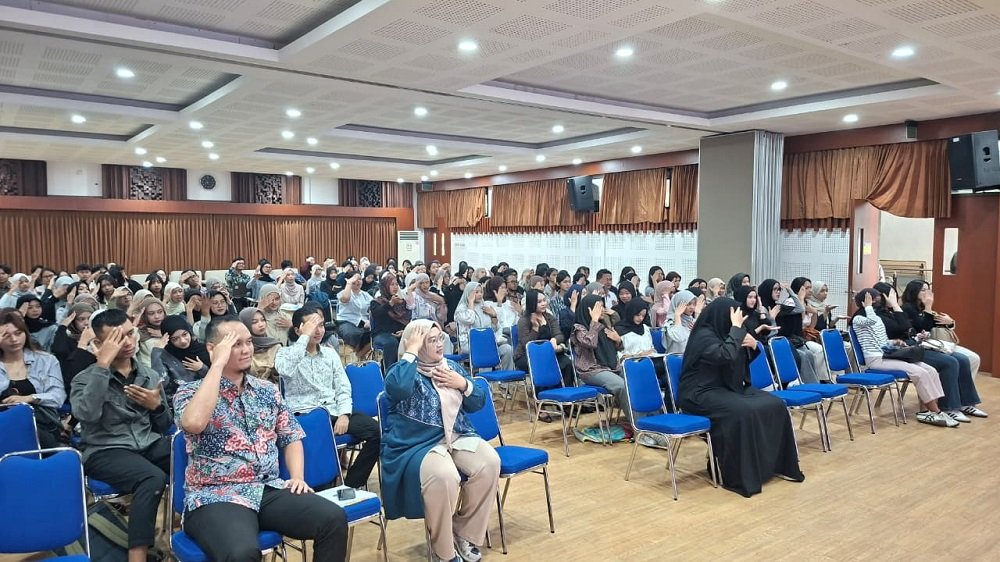
en.malanginspirasi.com – The Faculty of Cultural Sciences (FIB) and the Faculty of Administrative Sciences (FIA) Universitas Brawijaya (UB) held a Disability Awareness Session titled “Embracing Diversity, Empowering Inclusion” at the Faculty of Cultural Sciences B Hall, Brawijaya University, on Thursday (May 7, 2026).
This session was a collaboration between the Introduction to Inclusive Education course in the English Language Education Undergraduate Program, Faculty of Cultural Sciences, and the Inclusive Education course in the Educational Administration Undergraduate Program, Faculty of Administrative Sciences.
This collaboration involved the course instructors: Dr. Ive Emaliana, M.Pd. and Dr. Frida Unsiah, M.Pd. from the Faculty of Cultural Sciences, as well as Aulia Luqman Aziz, S.S., S.Pd., M.Pd. and Dr. Khurotin Anggraeni, M.Pd.I. from FIA.
The session took place from 8:00–10:00 a.m. WIB and featured two students with disabilities served as speakers, accompanied by Cyndiarnis Cahyaning Putri, M.Kn., a Sign Language Interpreter from the Brawijaya University Disability Services Center.
The Head of the Language Education Department, Faculty of Cultural Sciences, UB, Dr. Moh. Hasbullah Isnaini, S.Pd., M.Pd., emphasized the importance of building awareness of inclusion in everyday life in his remarks.
“Inclusion is about appreciating it and trying to make it a part of our lives. We must cultivate awareness together. I am proud of this activity because we can see another side of the lives of our brothers and sisters with disabilities.” “With awareness, we can stand side by side and live together,” he said.
Also Read:
Welcoming Audience with Disabilities, Sri Untari Pushes for Strengthening of Perda
He also encouraged students to make the most of the event to learn directly from the lived experiences of the students with special needs who were present as speakers.
One of the speakers, Sania Khoridatur Rohmi, a Bachelor of Accounting alumna from UB who has been deaf since birth, shared her experiences during her studies on campus.
She recounted how classes during the COVID-19 pandemic, which were largely conducted via Zoom, still presented challenges for deaf students.
According to Sania, the Sign Language Interpreter (JBI) support service at UB was very helpful, even though the number of assistants and sign language training was still limited at that time.
She also revealed that lecturers and teaching assistants sometimes explained things too quickly, making it difficult to understand the material.
“Deaf is not a bad word. “There’s no need to feel sorry for us, because the only difference is the way we communicate,” Sania explained to the participants.
In her session, Sania also introduced the differences between hearing and deaf cultures, explained the differences between BISINDO and SIBI, and shared communication etiquette with deaf people, such as speaking clearly, maintaining eye contact, using expressions and gestures, and simple ways to attract attention like waving or politely patting the shoulder.
During the session, participants had a chance to learn basic sign language directly.
Another speaker, Johana Gabriela, a blind Indonesian Language Education student from the class of 2021, also shared her perspective on daily life as a visually impaired individual.
Johana explained that she can still see light, but cannot clearly see people’s faces.
“I usually recognize people by gestures or even by their distinctive scent,” she said with a smile.
Meanwhile, Aulia Luqman Aziz, S.S., S.Pd., M.Pd., considered this cross-class collaboration to be an important learning enrichment for students.
“This class collaboration activity is enriching “This activity provides students with material to better understand students with disabilities, not only theoretically but also through firsthand experiences and stories from the speakers,” he said.
Through this activity, students are expected to not only understand the concept of inclusive education academically but also develop empathy, social awareness, and skills for more inclusive interactions in their daily lives.