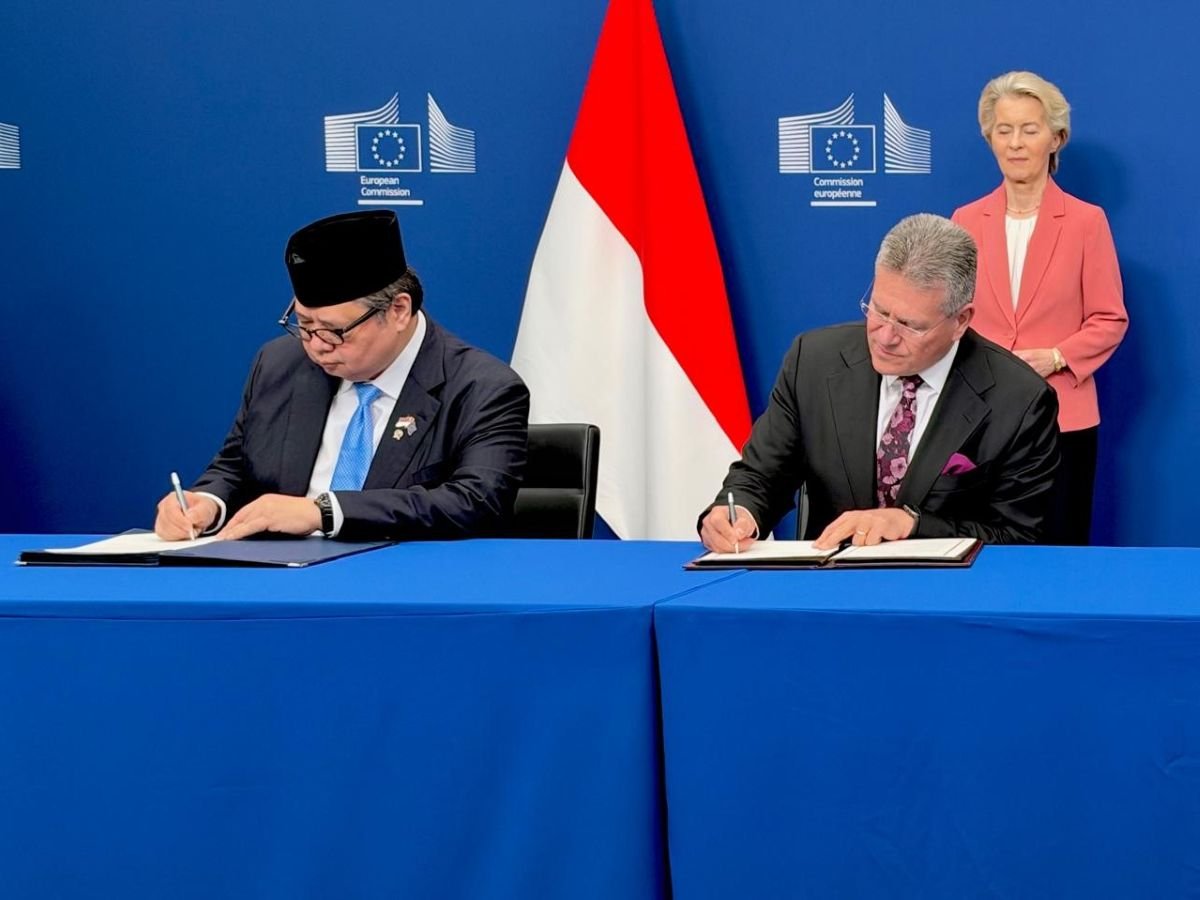
en.malanginspirasi.com – Indonesia and the European Union have taken another step toward strengthening their economic partnership following the signing of the Indonesia-European Union Investment Protection Agreement (I-EU IPA).
Coordinating Minister for Economic Affairs Airlangga Hartarto signed the agreement alongside European Commissioner Maroš Šefčovič. Airlangga also signed a joint press statement as part of the broader efforts to deepen economic cooperation between the two sides.
The signing ceremony was attended by Indonesia’s Ambassador to Belgium, Andy Rachmianto, Deputy Minister of Investment and Downstreaming Todotua Pasaribu, and Deputy Minister of Industry Faisol Riza.
European Commission President Ursula von der Leyen, who witnessed the ceremony, highlighted the strategic significance of the agreement.
She noted that it would connect the European Union’s market of approximately 450 million people with Indonesia, the largest economy in Southeast Asia.
Also read:
Kemenkeu Confirms 44 LPDP Recipients Violated Service Agreements
Von der Leyen also emphasized the potential benefits for around 730 million people across the two regions, particularly through improved market access, greater regulatory certainty, and a more stable environment for trade and investment.
In their joint press statement, Airlangga described the signing of the two agreements as the beginning of a new chapter in Indonesia-EU economic relations.
He expressed hope that the agreements would be followed through effectively and deliver tangible benefits, particularly by supporting economic growth and improving people’s welfare in both regions.
Meanwhile, Šefčovič stressed that the signing was not the final stage of their cooperation. He explained that the agreements’ success would ultimately depend on how effectively both parties promoted and implemented the commitments they had made.
With the signing of the Indonesia-EU Comprehensive Economic Partnership Agreement (I-EU CEPA) and the I-EU IPA, Indonesia and the European Union are moving into the next phase of their bilateral economic relationship.
The upcoming priorities include completing the ratification process, preparing for implementation, and maximizing the trade and investment opportunities created by the agreements.