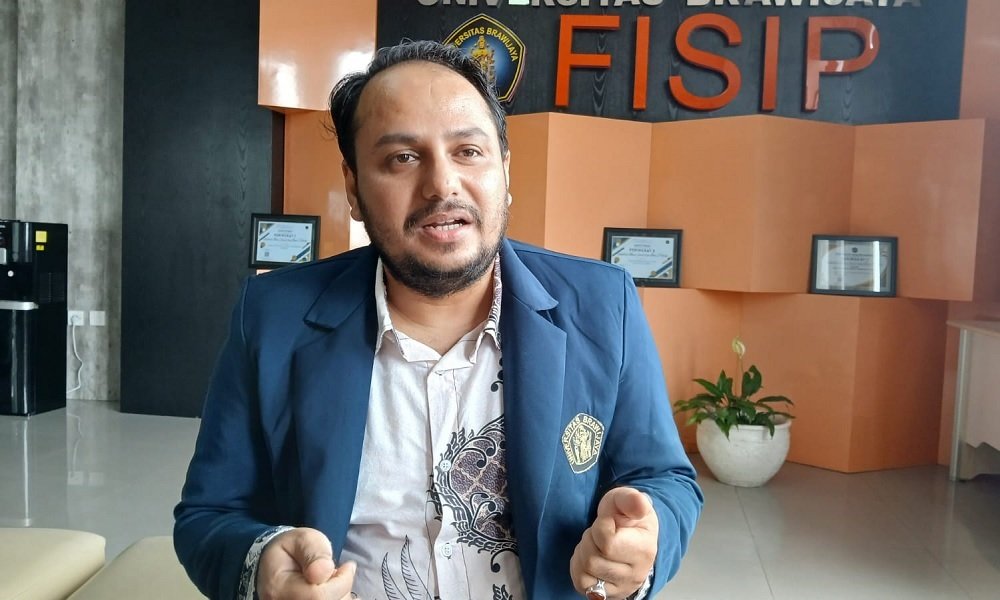
EN.malanginspirasi.com – Lecturer in the Department of International Relations at the Faculty of Social and Political Sciences (FISIP), Brawijaya University (UB), Abdullah, S.Sos., M.Hub.Int., has evaluated that the escalation of tensions between Iran and the United States extends far beyond the Middle East region. It carries significant implications for the global geopolitical landscape, including Indonesia’s strategic position.
According to Abdullah, this situation must be understood in the context of Indonesia’s recent inclusion in the Board of Peace (BoP), where the United States serves as one of the primary leaders. This development places Indonesia in a delicate and not entirely favorable position.
“With Indonesia now part of the BoP and the US acting as a key leader, the country finds itself in a configuration vulnerable to external pressures. Indonesia may face diplomatic, economic, and even security-related pressures to demonstrate alignment with certain parties, Abdullah explained.
He further elaborated that if Indonesia is perceived as tilting toward one power bloc, it risks creating friction with the opposing side. Such perceptions could lead to tangible consequences, including trade barriers, declining foreign investment, disruptions in defense cooperation, and reduced political support in multilateral forums.
Conversely, if Indonesia adopts an overly defensive or ambiguous stance regarding the conflict, its credibility as an emerging middle power could be undermined.
“If Indonesia appears too ambiguous, there is a risk it will be viewed as failing to actively uphold international law and global stability,” Abdullah warned.
“This could erode the country’s longstanding credibility in pursuing its independent and active (bebas aktif) foreign policy,” he added.
Beyond geopolitics, Abdullah highlighted the direct domestic repercussions. Escalating tensions that disrupt global energy stability could drive up fuel prices and the cost of basic commodities, effects that would be felt by ordinary citizens — including university students.
“For students, the impacts are immediate and concrete: higher transportation costs, rising prices for daily necessities, and increased economic pressure on families,” he noted.
In the medium term, the resulting fiscal strain on the state budget — particularly from ballooning energy subsidies — may force adjustments in public spending.
Abdullah cautioned that critical sectors such as education, including scholarships and student development programs, could suffer if the government’s budgetary burden grows significantly.
Conflict Risks Reviving Extremism
He also addressed the problematic framing of the conflict in international public discourse. The war is frequently portrayed as an internal clash within the Islamic world, pitting Iran against Arab Gulf states aligned with the United States. However, Abdullah stressed that the core issues are fundamentally political and strategic rather than purely religious or ideological.
“This conflict has been framed as a war within the Islamic world, whereas the reality is political. Iran refuses to submit to US dominance, and under Article 51 of the UN Charter, it claims the legitimate right to self-defense,” he said.
Abdullah explained Iran’s perspective: the country interprets the UN Charter as granting it legitimacy to launch retaliatory strikes against US military bases and assets in the Gulf region, viewing those locations as the origin points of attacks against it.
In light of these complexities, he underscored the vital responsibility of universities, academics, and community leaders to provide nuanced, comprehensive explanations to the public and avoid oversimplification. Reducing the conflict to simplistic ideological narratives risks reviving extremist thinking and radical elements.
“Campuses must clearly communicate that this is primarily an issue of international politics, not merely an ideological or religious confrontation. Public education on these matters must be handled wisely to prevent societal polarization,” Abdullah emphasized.
Through academic platforms such as the Iran Corner and sustained research initiatives, Brawijaya University (UB) aims to offer data-driven and scientifically grounded perspectives on global issues.
Abdullah concluded that Indonesia’s primary challenge today is not simply choosing sides, but rather preserving the consistency of its free and active foreign policy principles amid intense geopolitical pressures.
“Indonesia must skillfully maintain balance, uphold its credibility, and continue contributing to global stability,” he stated.
This discussion highlights the crucial role of academic institutions as intellectual spaces that critically examine global issues while connecting them to national interests and their real-world effects on society.
(Article source: EV/UB Public Relations, rewritten by the Malang Inspirasi Editorial Team)