en.malanginspirasi.com – The Language Development and Cultivation Agency (Badan Bahasa) appreciates the efforts of the Indonesian Bishops’ Conference (KWI) in promoting the official use of Indonesian within the Vatican through its Vatican News channel.
The Head of Badan Bahasa, Hafidz Muksin, even hopes that one day the world’s Catholic Church leaders will use Indonesian in their official greetings.
“Who knows, maybe the Pope will speak a few words in Indonesian. How are you, good morning, thank you, for example,” said Hafidz Muksin in a written statement received by InfoPublik on June 8, 2026.
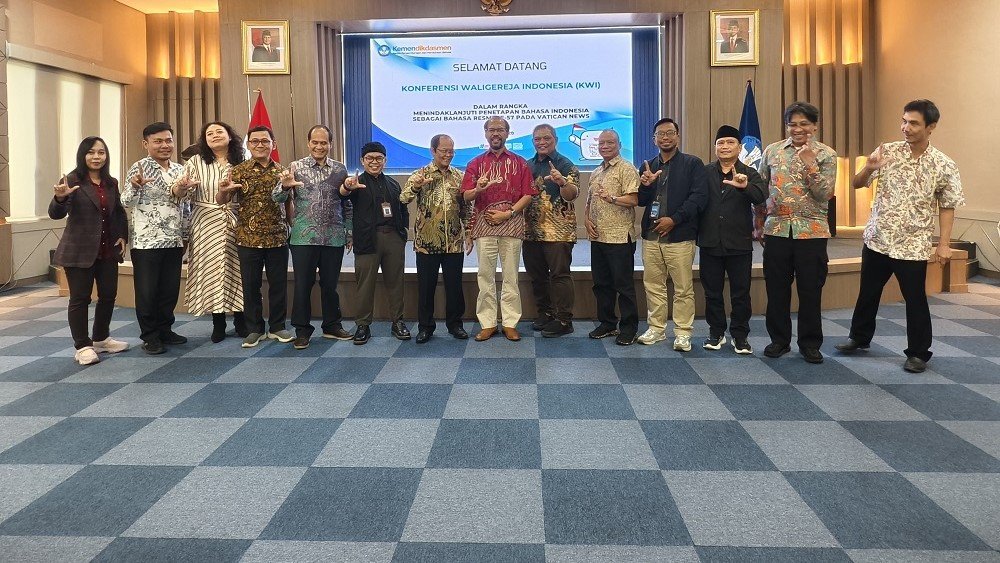
This statement was made during a visit by the KWI’s Social Communications Commission, accompanied by the Indonesian Catholic Journalists Association (PWKI).
The meeting was a follow-up to the signing of a memorandum of understanding between the Indonesian Language Council (KWI) Commission on Social Communications and the Vatican Dicastery for Communications at the Vatican on March 25, 2026.
Also attending the event were the Secretary of the Language Agency, Ganjar Harimansyah, and the Head of the Center for Language and Literature Empowerment, Iwa Lukmana.
The KWI Commission on Social Communications was represented by Petrus Noegroho Agoeng, along with several administrators and representatives from the Indonesian Language Forum (PWKI).
According to Hafidz, the presence of Indonesian in Vatican News is not simply the result of automatic translation based on artificial intelligence.
Yet, it is also a part of strengthening the position of Indonesian in the global communication space.
“This isn’t using AI, so we can read the content in Indonesian,” he said.
He believes that in the digital era, the quality of translation and the delivery of information about Indonesia to the international community is crucial.
Furthermore, Hafidz noted that the spread of Indonesian abroad has also been carried out through missionaries and teachers who carry Indonesian cultural missions to various countries.
However, on the other hand, the Language Agency also expressed concern about the declining public interest in the use of Indonesian domestically.
“It’s not like a national symbol; for example, if a flag is stepped on, we become extremely angry. But why are we silent about language? This is our sovereignty,” Hafidz asserted.
He highlighted the phenomenon of using foreign terms that are considered more economically and socially valuable than using Indonesian.
“Black coffee becomes black coffee or Americano, making it seem more expensive. Ultimately, we value things with foreign overtones more,” he said.
Also Read:
Meanwhile, Iwa Lukmana explained that Indonesia still faces challenges in promoting its linguistic identity internationally.
“Indonesia is known as The Biggest Invisible Country, the largest country invisible in the context of language,” he explained.
According to Iwa, many people worldwide still consider Indonesian to be the same as Malay, so cultural diplomacy efforts are needed to strengthen Indonesian’s identity globally.
As part of its soft diplomacy strategy, the Language Agency continues to expand Indonesian language teaching in various countries.
One example is the establishment of an Indonesian language study program at Al-Azhar University, Egypt.
“We’ll go to Al-Azhar first so the rest of the Islamic world will see it too,” said Iwa.
He added that spreading Indonesian is an important part of a grand strategy to improve Indonesia’s position on the global stage.
On that occasion, Ganjar Harimansyah also invited the Indonesian Journalists Association (KWI) and the Catholic journalist community to help enrich the vocabulary in the Big Indonesian Dictionary (KBBI), especially terms with Catholic nuances.
Currently, Ganjar said, of the more than 200,000 words in the KBBI, only around 268 words are related to Catholic traditions.
This step to strengthen Indonesian aligns with the government’s Asta Cita (Asta Cita) to strengthen national identity, expand Indonesian cultural diplomacy, and increase the nation’s competitiveness at the global level through language and culture.