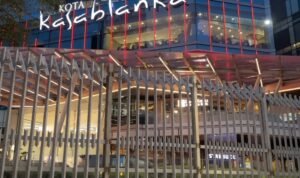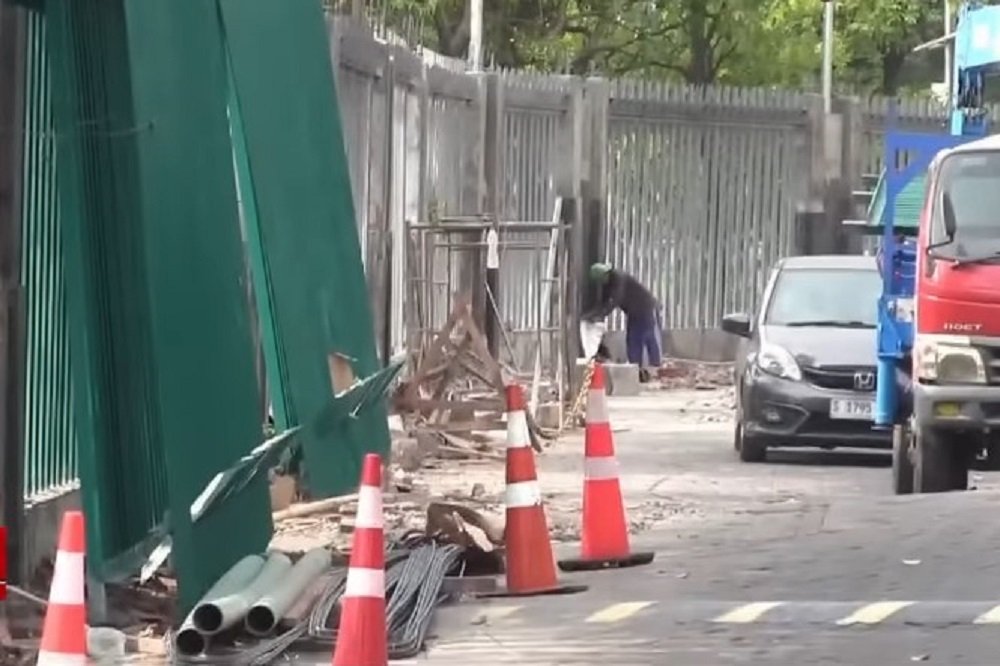
en.malanginspirasi.com – The owners of Indonesia’s two largest shopping center chains, Lippo Group and Pakuwon Group, confirmed that the installed fences at several malls were a local management initiative, not a company policy.
They emphasized that national security conditions remain conducive, thus eliminating the need for the installation of perimeter fences.
Lippo Group Chairman and Deputy Chairman for Foreign Affairs of the Indonesian Chamber of Commerce and Industry (Kadin), James T. Riady, stated that all Lippo-owned malls had installed fences during past unrest in Indonesia.
However, as the security situation improved, these fences have long been removed.
“Previously, all malls installed fences during unrest. Now they are no longer necessary because the situation has calmed down,” James said in a KADIN press release.
Similarly, Pakuwon Group founder Alexander Tedja confirmed that the fence installed at Kota Kasablanka (Kokas) Mall in South Jakarta would soon be removed.
According to him, the fence installation was a local management decision without direction from shareholders or the head office. “It was a local management policy and will be removed soon,” he said.
Also Read:
Jakarta and Surabaya Malls Install Tall Perimeter Fences, Fueling Public Speculation
Bali Running Club Entourage Pauses Events Amid Discrimination Allegations and Immigration Crackdown
Previously, Minister of Housing and Settlements (PKP), Maruarar Sirait, admitted to having communicated directly with Alexander Tedja regarding the controversy surrounding the installation of fences at the mall.
Based on that communication, Alexander emphasized that the fence at Kota Kasablanka would be dismantled and the area’s redevelopment would be adjusted to comply with applicable regulations to avoid creating misperceptions among the public.
“I have also spoken directly with Mr. Alex Tedja. He said it was simply a local management initiative and would be resolved soon,” said Maruarar.
Maruarar also appreciated the stance of James Riady and Alexander Tedja, who openly stated that Indonesia’s security situation remains good.
“They are mall and hotel owners in Indonesia. The stance of these two mall owners is commendable because our security situation is indeed good,” he said.
James believes there is no reason for the public to worry about the national social and economic situation.
He believes the government has succeeded in maintaining people’s purchasing power through various strategic policies, such as maintaining the prices of subsidized fuel, 3-kilogram LPG, and subsidized household electricity rates amidst global energy price fluctuations.
“As long as subsidized fuel prices don’t increase, 3-kilogram LPG doesn’t increase, and subsidized household electricity rates remain the same, there’s no reason for the public to be anxious,” he said.
He added that this optimism is reflected in the development of the shopping center industry, which is currently showing a positive trend. Demand for business space from tenants is even said to exceed the availability of space in many shopping centers.
“Right now, there’s a space shortage. Demand for store openings is greater than the supply of space in modern shopping centers. This is a golden age for the mall business,” he said.
According to James, the positive outlook has encouraged the Lippo Group to continue expanding. The company currently manages 106 shopping centers, consisting of 71 malls and 35 shopping centers in more than 29 cities in Indonesia.
He emphasized that the high demand for business space and developer expansion are strong indicators that the business community remains confident in the national economic outlook.
“If the situation is unsafe, tenants certainly won’t be competing to open stores. The fact that developers continue to expand demonstrates business confidence in Indonesia’s economic prospects remains strong,” he said.
James reiterated that the installation of fences in several locations was an isolated incident and did not reflect the overall condition of the shopping center industry.
“It was just a local management initiative, not a policy of the owner or head office. Even after confirmation, such fences were found to be unnecessary,” he asserted.
Alexander Tedja also stated that the issue of mall fences had been widely discussed on social media.
However, he stated that the current security situation remains conducive, so there is no need to install fences in shopping centers.