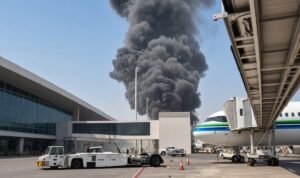
en.malanginspirasi.com – Saudi authorities announced on Monday, October 12th that the operational suspension at King Khalid International Airport in Riyadh has been extended following deadly weekend strikes launched by Yemen’s Iran-aligned Houthi movement, Reuters reported.
The Saudi civil aviation authority confirmed that operations at the capital’s main hub, which stands as Saudi Arabia’s second-busiest airport after Jeddah, were temporarily halted to “allow for the completion of procedures to ensure the safety and operational readiness of the airport’s facilities”.
The shutdown comes in the wake of a devastating assault on Saturday that claimed the lives of 13 people and left over 300 injured, marking the deadliest attack within the kingdom in more than a decade.
A follow-up strike on Sunday resulted in one additional death and nearly a dozen further injuries.
The sudden escalation represents one of the most severe disruptions to the Saudi aviation sector in years, further straining an industry already navigating broad regional instability.
Also Read:
Deadly Strike on Riyadh Airport, Twelve Dead and Over 300 Injured
Flight-tracking service Flightradar24 recorded empty skies over Riyadh, while aviation analytics firm Cirium noted that 99.7 percent of all scheduled flights at the airport were canceled on Sunday.
The crisis has prompted a wave of international flight cancellations and security advisories.
Lufthansa Group announced the cancellation of all flights to Riyadh through October 16.
Air France-KLM extended its existing route suspensions to and from the capital through the end of the month.
Regional carriers have also felt the impact, with Abu Dhabi-based Etihad Airways extending cancellations for approximately 20 flights bound for Riyadh, Jeddah, and Dammam through Tuesday.
Concurrently, the Federal Aviation Administration advised American commercial carriers to exercise heightened caution when navigating Saudi airspace.
Beyond immediate travel disruptions, the escalating conflict with the Houthis is raising broader economic anxieties. Saudi Arabia’s real GDP is currently projected to contract by 3.6 percent this year, impacted in part by reduced oil sector activity.
The turmoil has also created significant uncertainty surrounding major upcoming events hosted in Riyadh, including the kingdom’s flagship investment summit and the WPC Energy Congress, where several prominent energy executives were recently removed from the event roster.