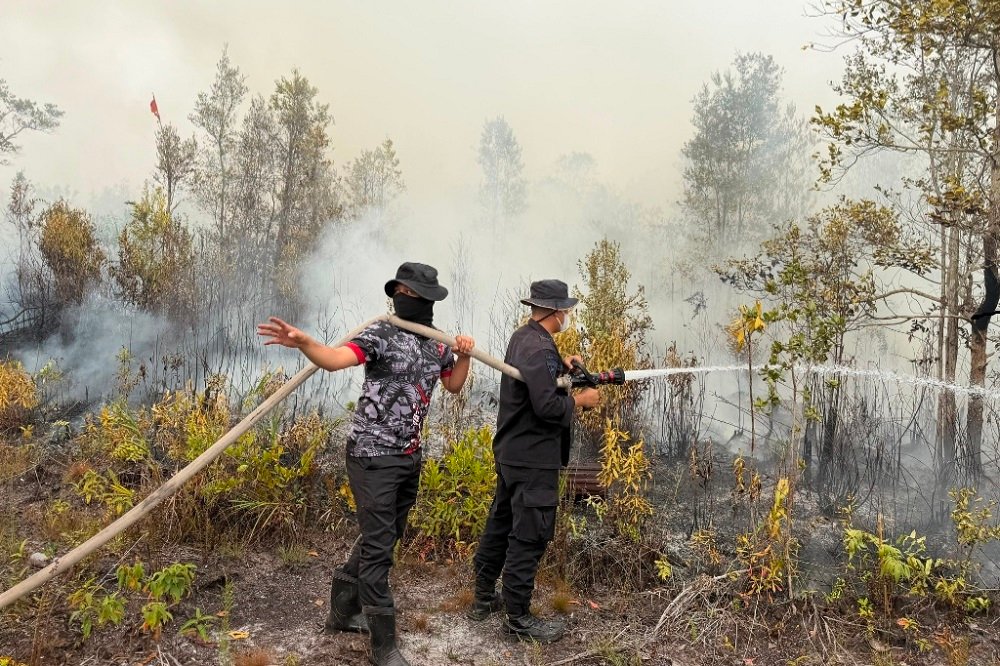
en.malanginspirasi.com – Thick smoke from raging forest and land fires in Indonesia’s Kalimantan provinces has blanketed large parts of Borneo and crossed into Malaysia.
It is turning midday skies gray and pushing air quality into unhealthy and very unhealthy levels.
The blazes, fueled by prolonged dry conditions under an intensifying El Niño, have reached near residential areas in places, disrupted daily life, closed schools, and displaced wildlife, including critically endangered orangutans.
Indonesian authorities reported thousands of hotspots concentrated on Borneo—the world’s third-largest island shared by Indonesia, Malaysia, and Brunei—with Indonesia occupying about three-quarters of the landmass.
Visibility in affected parts of Kalimantan dropped to as low as 1–10 meters in some areas, contributing to traffic accidents and flight delays.
Also Read:
TNBTS Fire Approaches B29; The Government Confirms Area Remains Safe
In Malaysia’s Sarawak state, which borders Indonesian West Kalimantan, air pollution index (API) readings in districts such as Serian reached very unhealthy levels (above 200), while multiple other stations logged unhealthy readings.
This prompted the temporary closure of nearly 600 schools, affecting around 200,000 students.
Residents on both sides of the border have reported breathing difficulties, stinging eyes, and the need to keep headlights on during daylight hours.
The human and ecological toll extends beyond air quality.
Fires have entered or approached peatland areas and forests that serve as critical habitat.
Conservation groups report orangutans being driven from their forest homes into plantations and settlements in search of food and safety, heightening risks of human-wildlife conflict.
In West Kalimantan’s Ketapang district, flames came within roughly 100 meters to 1 kilometer of an orangutan rehabilitation center housing more than 60 rescued Bornean orangutans.
It required intensive firefighting efforts by government teams, the military, police, and nonprofit staff. Similar displacements and habitat threats have been documented in Central and East Kalimantan.
Malaysia Takes Action
Malaysia has stepped up regional coordination.
Natural Resources and Environmental Sustainability Minister Datuk Seri Arthur Joseph Kurup has led efforts to strengthen joint monitoring of hotspots, enforcement against open burning, and potential cross-border operations such as cloud seeding.
He has emphasized ASEAN mechanisms and bilateral engagement with Indonesia, noting that haze is a shared regional problem exacerbated by the “super El Niño” phase bringing drier weather and reduced rainfall.
Malaysia has also activated Alert Level 2 under the ASEAN Agreement on Transboundary Haze Pollution.
On the Indonesian side, President Prabowo Subianto ordered a coordinated national response involving the Forestry Ministry, National Disaster Management Agency (BNPB), military, police, and regional governments. Authorities have deployed dozens of aircraft and helicopters for water bombing, cloud seeding (weather modification), and patrols across priority provinces including West, Central, and South Kalimantan, as well as parts of Sumatra.
Thousands of ground personnel from Manggala Agni fire brigades, disaster agencies, and volunteers are engaged. Police in Central Kalimantan have detained suspects linked to alleged arson and illegal land clearing. Officials have warned of legal action against anyone starting open fires.
Despite the mobilization, frustration has grown over the recurring nature of the crisis. Many fires are linked to land clearing—often involving peatlands that burn underground and release dense smoke—for agriculture, including palm oil and other plantations.
Monitoring platforms have recorded substantial burned areas this year, with July alone seeing roughly 182,000 hectares scorched in some estimates, far exceeding earlier periods.
Critics and residents point to delays in containment and the need for stronger prevention beyond seasonal firefighting.
Social media has filled with calls for prayers, sustained government action, and international support, reflecting both immediate hardship and longer-term concerns about environmental management amid climate-driven dry seasons.