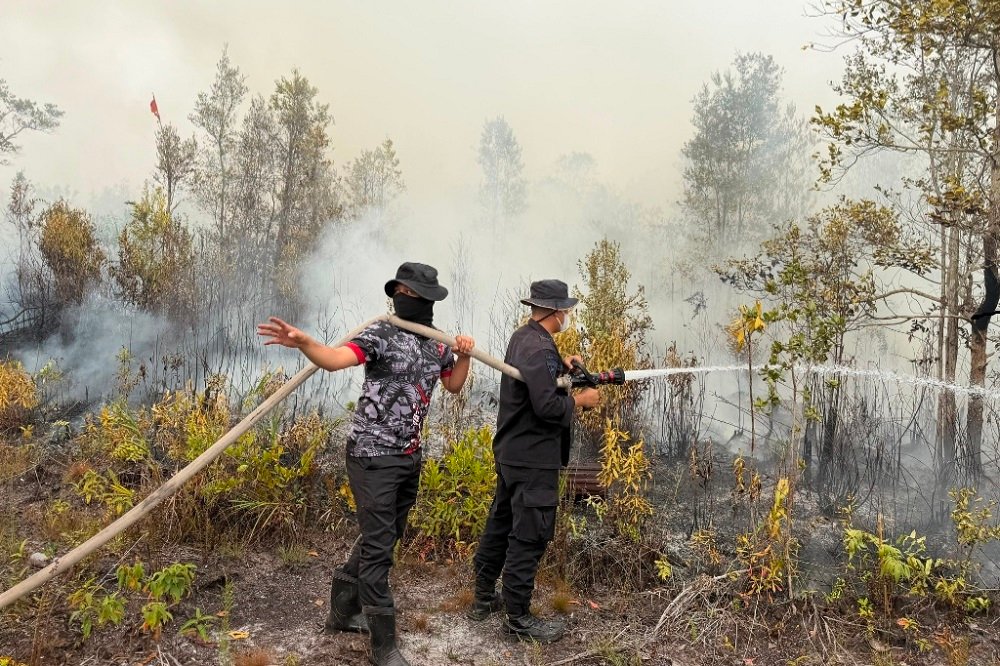
en.malanginspirasi.com – Driven by parched conditions across the islands of Kalimantan and Sumatra, a massive surge in Indonesian wildfire emissions has pushed the country’s carbon dioxide readings to the highest level in the world, according to recent data reported by Reuters.
Figures from the European Union’s Copernicus climate monitoring portal, Fire Emissions Watch, show that Indonesia generated 19.7 million metric tons of fire emissions between September 1 and September 7.
The spike allowed Indonesia to surpass Russia’s emissions during the same week and account for more than a third of the global total.
While Indonesia regularly faces seasonal fire risks, a severe “super-El Niño” weather pattern has brought extreme heat and prolonged drought, resulting in what officials describe as the nation’s most severe fire season in 11 years.
“We do expect to see some fires across the region at this time of year, but with El Niño, it clearly just gives a big enhancement to them,” said Mark Parrington, senior scientist at the Copernicus Atmosphere Monitoring Service in Bonn.
“It’s much drier, it’s hotter, and when there’s ignition, these fires burn in a far more extreme way,” he continued.
Copernicus data indicates that emission intensity reached over 1,500 kg per square kilometer during the first week of September—exceeding Russia’s rate tenfold.
The heaviest concentrations were recorded in eastern Sumatra and Kalimantan.
Also Read:
An Orangutan Named Sempurna Dies from Smoke Inhalation in Kalimantan Fires
While weekly emissions remained slightly below the 21.7 million tons recorded during the major 2015 El Niño event, they surged 273% above the seasonal average.
Air quality has deteriorated sharply as a result. In West Kalimantan, the city of Pontianak recorded an Air Quality Index reading of 394 according to monitoring firm IQAir, far past the hazardous threshold of 300.
In a statement to Reuters, Indonesia’s environment ministry noted it was tracking the dangerous air quality readings in Kalimantan and other regions “with concern.”
The ministry stated it is keeping tabs on the Copernicus data, while adding that the figures do “not directly reflect air quality conditions in a specific area” and require broader context.
Data from environmental group YKAN highlights a rapid late-summer escalation. While 202,000 hectares (780 square miles) burned between January and July—roughly a third of the burnt area during the same timeframe in 2015—the situation worsened significantly in August.
“However, August data are estimated to show a significant increase of around 600,000 hectares, particularly in Kalimantan, Sumatra and South Papua,” said Nisa Novita of YKAN.
For comparison, wildfires consumed 2.6 million hectares across Indonesia throughout 2015.
National tracking platform Sipongi, using NASA Terra and Aqua satellite data, recorded 13,443 hotspots between August 1 and September 8, compared to 9,454 hotspots during the corresponding period in 2015.
Even with these high counts, satellite-based tracking systems may obscure the full scale of the destruction.
“One of the aspects with peat fires is if they’re burning at low temperatures or underground, they’d be below the detection limit of the sensors, which means we’re not actually seeing them,” Parrington noted.
The ongoing crisis carries severe environmental and public health risks; research following the 2015 disaster estimated that daily emissions eclipsed those of the entire European Union and caused over 100,000 premature deaths across Indonesia, Singapore, and Malaysia.
Experts caution that the current crisis could continue for weeks.
“We have to remember that this is still the beginning of the season, and we expect the fires to continue and the emissions to keep increasing, potentially through to the end of October, which is what we saw in 2015,” Parrington said.
“In two months we’ll know how extreme this year has been, but the early indications are that it is at pace, if not slightly above those previous El Niño years,” he concluded.