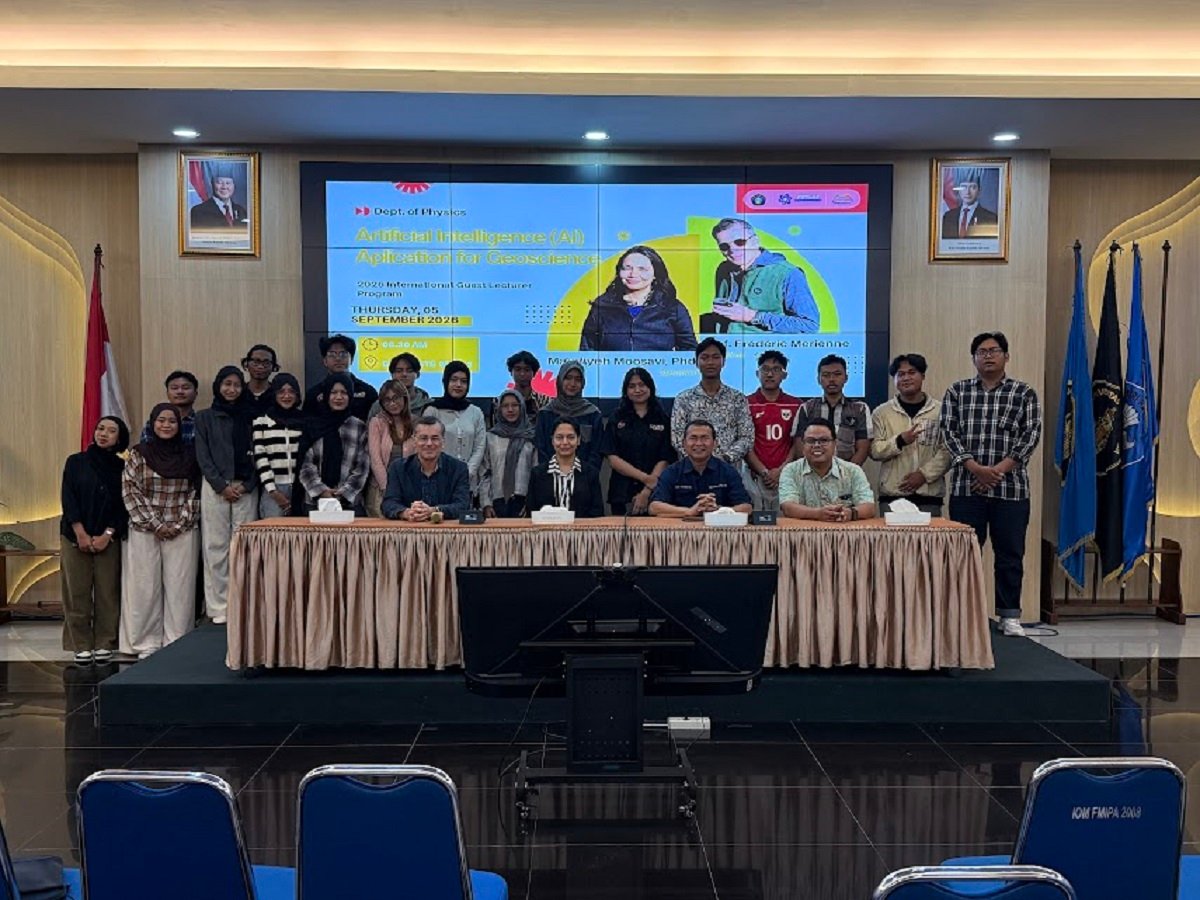
en.malanginspirasi.com — The Department of Physics, Faculty of Science, Technology, and Mathematics (FSTeM), Universitas Brawijaya (UB), convened the 2026 International Guest Lecturer Program under the theme “Artificial Intelligence (AI) Application for Geoscience” on Thursday, November 5, 2026.
Held at Banquet Hall MC 1.1 beginning at 08:30 WIB, the academic forum at FSTeM UB featured two distinguished scholars from Arts et Métiers, France: Mahdiyeh Moosavi, Ph.D., and Prof. Frédéric Merienne.
The guest lecture reflects a strategic initiative by the Department of Physics within FSTeM UB to broaden students’ academic horizons while strengthening international research networks in science and technology.
The chosen theme underscores the rapid evolution of Artificial Intelligence (AI) and its transformative potential in advancing Earth sciences.
Both speakers bring extensive academic and research expertise in digital technology development.
Mahdiyeh Moosavi, Ph.D., a researcher and academic at Arts et Métiers, specializes in machine learning, data analytics, and virtual reality (VR).
Her work focuses on developing human-interaction models within virtual environments to enhance user experience and immersion, offering FSTeM attendees critical insights into how AI and data-driven methodologies can address complex, multidisciplinary challenges.
Also Read:
FSTeM UB Mathematics Lecturers Explore Joint Research and Funding Collaboration with UTP’s CeRDaS
Meanwhile, Prof. Frédéric Merienne, a senior professor at Arts et Métiers, possesses decades of experience in technological engineering and virtual reality research.
Having earned his engineering degree from Arts et Métiers in 1992 and his doctorate from the National Polytechnic Institute of Grenoble in 1996, he has served as a professor at Arts et Métiers since 2004, actively contributing to research at Institut Image and the LISPEN laboratory (Laboratoire d’Ingénierie des Systèmes Physiques et Numériques).
His research encompasses VR systems, human-digital environment interaction, and immersive technology applications across industrial, healthcare, and engineering sectors.
The synergy of both scholars’ expertise provided FSTeM participants with a multidisciplinary perspective on emerging AI technologies.
Integrating machine learning, advanced data analytics, and virtual visualization holds substantial promise for optimizing geoscientific data processing, modeling complex geological phenomena, and presenting spatial and subsurface information through interactive platforms.
Throughout the session hosted by FSTeM UB, participants gained in-depth exposure to AI-driven applications across diverse geoscientific domains.
Merging artificial intelligence with Earth sciences represents a pivotal advancement in enabling more precise data interpretation, predictive geological modeling, and technology-based analysis of natural phenomena.
Engaging directly with international researchers allowed FSTeM UB students to examine global research trends firsthand, particularly regarding computational solutions for geoscientific challenges.
The academic exchange also fostered a culture of scientific inquiry, sharpened critical thinking skills, and encouraged students to pursue interdisciplinary research initiatives.
Furthermore, this program aligns with FSTeM UB’s broader commitment to advancing higher education quality through academic internationalization.
Interactions with international faculty are expected to catalyze joint research opportunities, knowledge transfer, and technological innovations responsive to societal and global industrial demands.
Beyond institutional excellence, the event organized by FSTeM directly supports the United Nations Sustainable Development Goals (SDGs), notably SDG 4 (Quality Education) by expanding student access to international academic expertise, and SDG 9 (Industry, Innovation, and Infrastructure) by promoting the adoption of artificial intelligence to drive innovation in geoscience.
Through the 2026 International Guest Lecturer Program, the Department of Physics at FSTeM UB aims to equip students with the competencies required to navigate evolving scientific frontiers and integrate computational and AI methodologies into future geoscientific research.