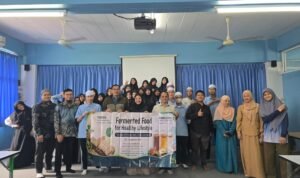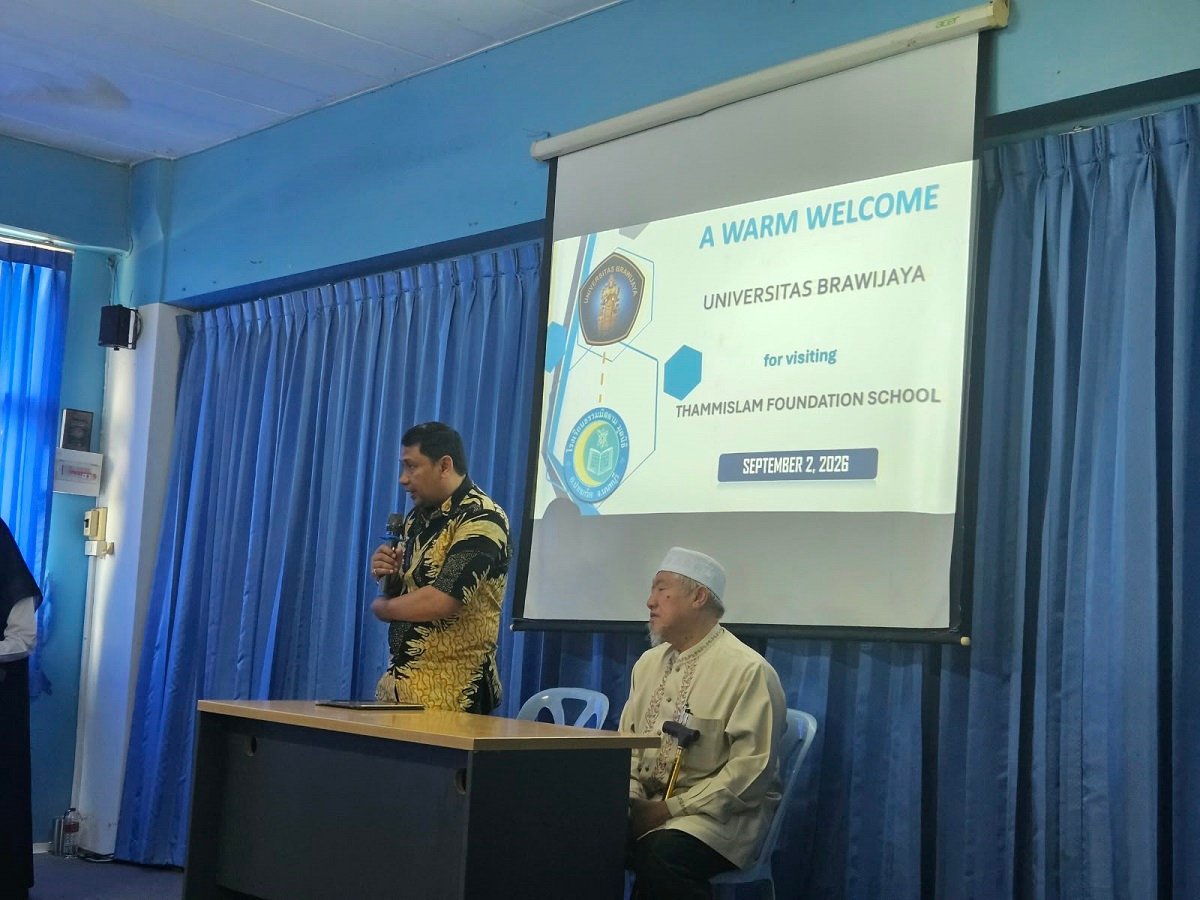
en.malanginspirasi.com – The Faculty of Agroindustrial Technology and Biosystems (FTAB) at Universitas Brawijaya (UB), through its Department of Biosystems Engineering, has strengthened its international network with the Special Branch Leadership of Muhammadiyah (PCIM) Thailand through an international community service activity at Thammislam Foundation School in Nonthaburi on September 2, 2026.
The program, themed “Recycling Waste Cooking Oil into Soap and Candles,” represents a concrete step by UB in implementing the tridharma of higher education (teaching, research, and community service) on the global stage, particularly within Indonesian education communities abroad.
The activity was led by Dr.Eng. Akhmad Adi Sulianto, S.TP., MT., M.Si., with team member Dr.Agr.Sc. Dimas Firmanda Al Riza, S.T., M.Sc.
PCIM Thailand representatives Bachtiar Rivai and Nabil fully supported the program as they facilitated coordination with Thammislam Foundation School.
Dozens of teachers and students in attendance warmly received the collaboration.
Environmental Impact Education and Demonstration of Value-Added Products
In the main session, the UB team provided in-depth education on the serious environmental impact of waste cooking oil.
They explained that improperly disposing of used cooking oil into waterways and soil can cause blockages, water pollution, and ecosystem damage, and can even increase greenhouse gas emissions if not managed properly.
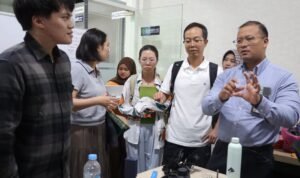
Going beyond theory, teachers and students received hands-on explanations and demonstrations on making liquid soap, bar soap, and aromatherapy candles from waste cooking oil.
The processes included filtering techniques, oil purification using natural adsorbents, the saponification process for soap-making, and the mixing of fragrance and coloring for aromatherapy candles.
Participants were highly enthusiastic throughout each stage, from stirring the soap solution to molding the candles.
To ensure sustainability, the UB team also provided the school with basic material and equipment kits so that practical activities can continue independently and be developed into a school entrepreneurship program.
Also Read:
The head of the community service program, Dr.Eng. Akhmad Adi Sulianto, emphasized that the choice of waste cooking oil as the theme is highly relevant to global environmental issues while also holding significant economic potential.
“We see waste cooking oil as a universal problem, not only in Indonesia but also in Thailand. People often throw it away because they consider it useless. Yet with a touch of simple appropriate technology, this waste can be transformed into a valuable, hygienic, and beneficial product,” said Dr. Akhmad Adi Sulianto.
“Through this activity, we wanted to instill two things at once. First, environmental awareness against carelessly disposing of used cooking oil. Second, a spirit of green entrepreneurship. We hope the students here can become agents of change, capable of turning waste from their own kitchens into business opportunities. This is a real form of circular economy,” he added.
He also emphasized the importance of biosystems engineering technology in solving everyday problems.
“The Department of Biosystems Engineering has a mandate to develop applicable technologies. Making soap and candles from used cooking oil is an example of how process engineering can provide simple, low-cost solutions that anyone can carry out, including school students,” he explained.
Appreciation from PCIM Thailand and the School
Meanwhile, PCIM Thailand representatives welcomed and highly appreciated Universitas Brawijaya’s initiative in choosing a PCIM-affiliated community as the site for this service activity.
Bachtiar Rivai, a PCIM Thailand representative, expressed his gratitude for the collaboration.
“We from PCIM Thailand are very grateful to Universitas Brawijaya, especially the Department of Biosystems Engineering, for coming and sharing highly valuable knowledge at Thammislam Foundation School. This activity aligns closely with Muhammadiyah’s mission of empowerment-based da’wah abroad. The knowledge of recycling used cooking oil is very practical, easy for students to understand, and can be put into practice immediately,” said Bachtiar Rivai.
He noted that there should be continuous strengthening of partnerships between Indonesian universities and the diaspora abroad.
“We hope this will not be the first and last activity of its kind. This is a good start in building a broader bridge of collaboration between UB and PCIM Thailand. There is still much potential for further community service that we can develop together, particularly in agricultural technology, renewable energy, and empowerment of PCIM-affiliated small and medium enterprises (SMEs) here,” he added.
Thammislam Foundation School also noted that the training opened new perspectives for students on how to protect the environment in creative ways.
A Real Contribution to the SDGs
This cross-country collaboration between Universitas Brawijaya, PCIM Thailand, and Thammislam Foundation School represents a tangible contribution by higher education institutions toward achieving the Sustainable Development Goals (SDGs).
The activity directly supports SDG 12 (Responsible Consumption and Production) by reducing and repurposing waste cooking oil into useful new products, thereby reducing environmental pollution.
At the same time, the activity also supports SDG 8 (Decent Work and Economic Growth) by introducing productive skills with the potential to be developed into environmentally based economic activities and social entrepreneurship at the school level.
Equally important, the overall program reflects the implementation of SDG 17 (Partnerships for the Goals).
The solid cooperation between an Indonesian academic institution, an Indonesian community organization in Thailand, and a local educational institution demonstrates that global partnerships are key to expanding positive impact and addressing shared challenges.
Through this international community service, Universitas Brawijaya affirms its commitment not only to excellence in education and research, but also to delivering direct solutions and benefits to the global community — in line with its vision of being a competitive and impactful World Class University.