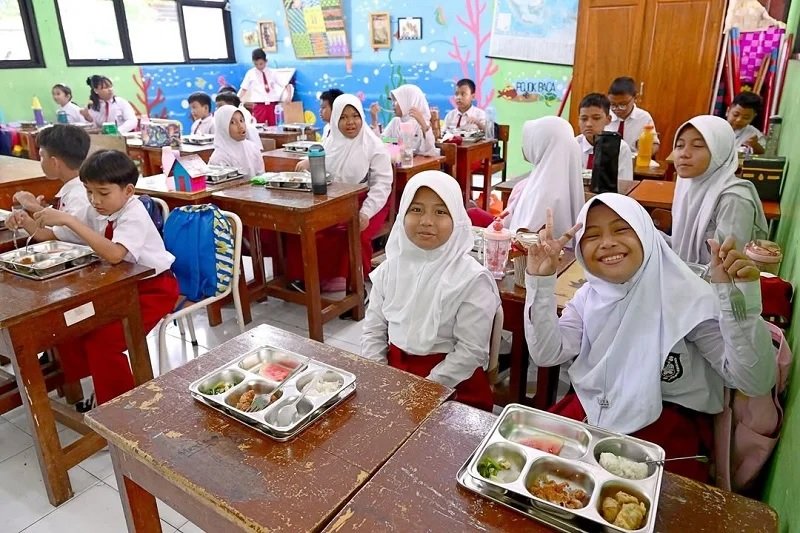
en.malanginspirasi.com — Indonesia’s Constitutional Court (Mahkamah Konstitusi/MK) has ruled that the government’s Free Nutritious Meals program (Makan Bergizi Gratis/MBG) can no longer be funded from the state’s education budget within the national budget (APBN). The ruling was delivered on Thursday, July 30, 2026, in case No. 40/PUU-XXIV/2026, a judicial review of Law No. 17 of 2025 on the 2026 State Budget.
The Court partially granted a petition filed by the Taman Belajar Nusantara Foundation along with several individual petitioners. Chief Justice Suhartoyo stated that the elucidation of Article 22(3) of the 2026 State Budget Law does not contradict the 1945 Constitution — but only conditionally, and only for the 2026 fiscal year.
For subsequent years, the Court ordered that funding for the meal program — which is not a core component of education — must be separated from the operational budget for education. That separation must be completed no later than the 2028 state budget, or within two years of the ruling.
The Court further encouraged the government to begin the separation as early as the 2027 budget, to accelerate compliance with the constitutional mandate.
In the legal reasoning, Constitutional Justice Enny Nurbaningsih affirmed that the constitutionally mandated minimum of 20 percent of the state and regional budgets for education is intended solely for the core components of education: students, educators and education personnel, facilities and infrastructure, curriculum, and educational evaluation and development.
“Financing for these core components does not include financing for the MBG program,” Enny said.
The Court found that classifying MBG spending under the education budget improperly broadens the meaning of “operational provision of education” and risks eroding the 20 percent mandatory spending requirement under Article 31(4) of the 1945 Constitution.
Even so, the Court affirmed that the MBG program itself remains constitutional as a priority program stemming from the 2024 general election, provided its funding is allocated separately from the education budget.
The Court also acknowledged that if MBG funding were immediately removed from the 2026 budget, the 20 percent education spending threshold would not be met. As a result, the 2026 state budget was upheld as constitutional, while the restructuring of the budget will take place gradually in subsequent years.
With this ruling, the government and House of Representatives (DPR) now have until 2028 to restructure the state budget in line with the Court’s decision — safeguarding the integrity of education funding while ensuring the state continues to meet its constitutional obligations in the education sector.