en.malanginspirasi.com – President Prabowo Subianto directed freefall-capable personnel from the Disaster Relief Rapid Reaction Force (PRCPB) to be ready in reaching hard-to-access forest and land fire sites in Riau Province.
He stated that this specialized capability should bolster firefighting operations while prioritizing personnel safety.
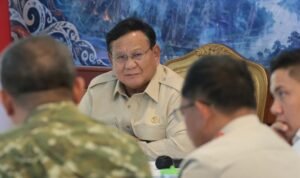
Prabowo issued this directive while chairing a limited meeting on forest and land fire management at the Forward Command Post in Pekanbaru City, Riau Province, on Monday, August 24th, 2026.
The President called for immediate action regarding hotspots before they could escalate into larger fires.
He also ensured the availability of personal protective equipment (PPE) for personnel working near hotspots or active fire sites.
“So, regarding the hotspots—have they been addressed? Immediately—water wells—we are already anticipating this. Is the PPE sufficient?” Prabowo asked.
According to the President, the requirement to wear PPE also applies to personnel deployed via freefall techniques.
“So, the team closest to the fire or hotspots must wear PPE? The freefall team? Can the freefall team wear PPE? They must wear it. They will, right? It’s feasible? The gear? The gear—okay. Good, good,” Prabowo emphasized.
Commander of Military Regional Command (Pangdam) XIX/Tuanku Tambusai, Major General Agus Hadi Waluyo, reported that five water-bombing helicopters had been deployed to support fire management efforts in Riau.
Also Read:
In addition to aerial firefighting, Weather Modification Operations (OMC) are being employed to maintain land moisture and increase soil water content.
“So far, the most effective activity we have carried out is the OMC (weather modification operation). The soil conditions in the Riau region differ from last year; we are wetting the land to ensure sufficient water content in the soil,” said Agus.
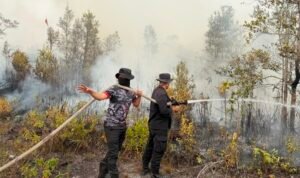
Water-bombing helicopters are focusing on locations that are difficult for ground crews to reach. Aerial firefighting is also being used to break the path of the fire and prevent it from spreading to other areas. “For areas inaccessible to ground troops, we employ water-bombing helicopters to create firebreaks, preventing the fire from jumping or spreading to other targets,” Agus added.
The TNI has also established a Rapid Reaction Force for Disaster Management (PRCPB), reinforced by paratroopers skilled in freefall techniques.
These personnel are prepared to reach specific locations and conduct direct firefighting operations on the ground.
“We have readied our best paratroopers to execute freefall jumps into specific areas, enabling them to extinguish fires directly on-site,” Agus explained.
Prabowo commended the utilization of these soldiers’ specialized skills for disaster management and community assistance.
“I believe this is a first in our history. Excellent. Indeed—freefall capabilities shouldn’t be reserved solely for ceremonial displays; now we are using them to help the people. Good, very good,” said Prabowo.
In addition to freefall operations, the TNI is employing various supporting methods, including rappelling, fast-roping, paramotors, and drones to monitor hotspots.
The construction of firebreaks and canal blocks can bolster ground operations.
These measures can halt the fire’s spread, particularly in peatland areas that remain at risk of reigniting even after cooling efforts.
“Mr. President, this approach has proven quite effective; we are widening the barriers because the terrain is peatland. Without them, even after cooling, the wind could carry embers and reignite the fire. Our current strategy to cut off the fire’s path and prevent it from spreading involves using firebreaks—or even containers—as well as water barriers and canal blocks,” Agus concluded.