en.malanginspirasi.com — The Sri Redjo Team from the Faculty of Agroindustrial and Biosystems Technology (FTAB), Brawijaya University (UB), participated in an international research competition as part of the 2026 ASEAN Regional Forum on Soil and Groundwater Challenges, Sustainable Remediation Strategies, and the Awards Ceremony for the Investigation and Remediation Research Competition.
The Sri Redjo Team consists of Faisal Adi Pambukotomo, M. Raihan Fithra Jannnatan, and Egant Zanuar.
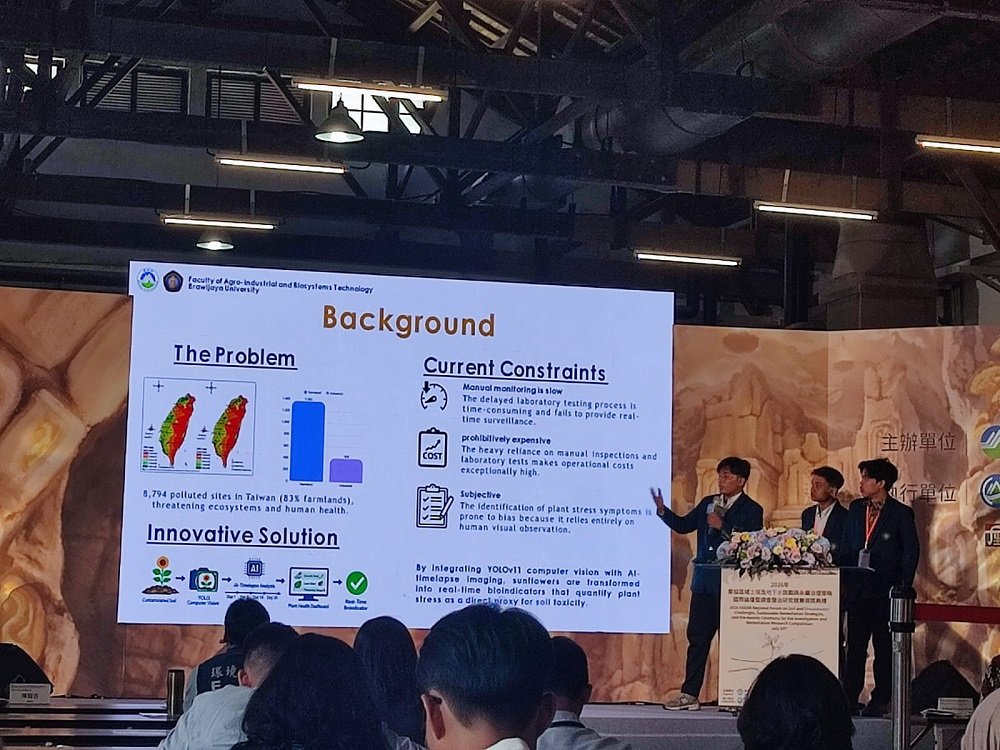
It was under the guidance of lecturer Aulia Nur M. At the event, the three represented UB’s FTAB by presenting their innovation titled “PhytoTracker: AI-Based Monitoring of Sunflower Phytoremediation in Contaminated Brownfields.”
PhytoTracker is an innovative artificial intelligence-based monitoring system designed to support the phytoremediation process using sunflower plants on contaminated land.
This system integrates image capture, computer vision technology, and AI-based analysis to identify plant conditions and stress symptoms more quickly, objectively, and sustainably.
Also Read:
FTP UB Transforms into Faculty of Agroindustrial and Biosystem Technology
The development of the innovation was in response to the limitations of conventional monitoring methods, such as reliance on visual observation, time-consuming laboratory testing, relatively high operational costs, and limitations in providing real-time information.
Through PhytoTracker, monitoring plant conditions becomes a supporting indicator in evaluating the recovery process of contaminated land.
This international forum brought together experts, academics, and participants from Indonesia, Thailand, Vietnam, and various other ASEAN countries to discuss the challenges of soil and groundwater pollution and their management strategies.
The event took place on Saturday, July 25, 2026, at Songshan Cultural and Creative Park, Taipei City, Taiwan.
The Sri Redjo Team’s participation was part of the efforts by FTAB UB to encourage students to produce technology-based innovations relevant to global environmental issues.
This participation also provided an opportunity to introduce UB students’ ideas in an international forum while strengthening academic networks and research collaborations in the ASEAN region.