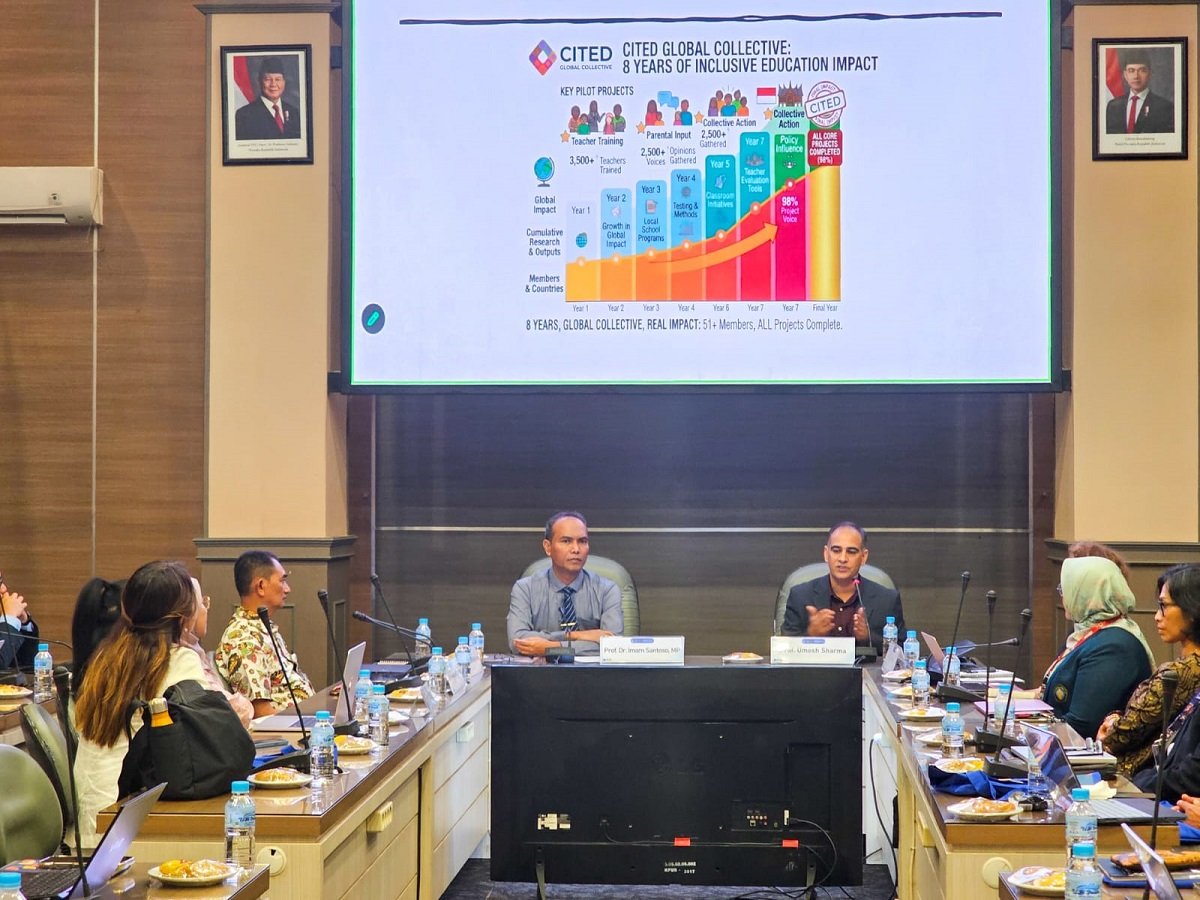
en.malanginspirasi.com – Universitas Brawijaya (UB) has partnered with the Consortium of Inclusive Teacher Education and Development (CITED) to host an international conference titled Belonging Without Borders: Strengthening Collective Commitment for an Inclusive World.
The event took place on Wednesday (October 28, 2026) at the UB Rectorate Building.
Vice Rector for Academic Affairs Prof. Dr. Ir. Imam Santoso, MP., said UB was honored to contribute to this international dialogue, which has been held in various parts of the world.
He expressed hope that the collaboration would produce practical and sustainable approaches that can be applied to institutional policy in Indonesia, as well as strengthen networks among researchers.
According to Prof. Imam, the conference theme carries a profound message: inclusive education is not merely about providing access to learning opportunities.
More importantly, it is about creating an educational environment in which every individual feels valued, respected, supported, and empowered to participate meaningfully, regardless of their background, abilities, or circumstances.
UB firmly believes that inclusion is both a fundamental value and a shared responsibility. Advancing inclusive education requires more than individual initiatives or institutional policies. It demands sustained commitment, partnership, and a collective willingness to learn from diverse experiences and perspectives.
“Through this opportunity, we can strengthen our joint action to create inclusive education,” he added.
Chair of the CITED Steering Group, Prof. Umesh Sharma, explained that CITED grew out of a simple question raised at a conference in Fiji in 2018: “What would happen if we stopped working individually?”
Also Read:
UB Joins Global Push for Sustainable Agriculture at Taiwan Summit
“We are a group of academics, teachers, researchers, and disability rights advocates from around the world who are passionate about developing strategies and resources to help teachers deliver inclusive education for all learners,” Prof. Umesh said.
UB itself has pursued institutional transformation in several areas to realize inclusive education. First, UB supports gender equality in campus administration.
“Women make up 52.2 percent of lecturers and 36.6 percent of educational staff, and 58 percent of UB students are also women,” Prof. Imam said.
Second, UB runs six affirmative action programs for disadvantaged regions and groups: ADik Papua, ADEM Papua, ADEM Repatriation, ADik 3T, a special admissions pathway for students with disabilities, and international student admissions.
“ADik is for students who completed primary and secondary education in Papua, ADEM is for students who completed their education outside Papua, and Repatriation is for those whose parents are Indonesian migrant workers,” Prof. Imam continued.
In addition, UB currently supports 329 active students with disabilities and 185 graduates across 74 study programs. These services are strengthened through programs run by the Sub-directorate for Services for Persons with Disabilities and Inclusive Education.
“This is reinforced through the integration of information and learning management systems via a one-stop system at ea.ub.braindevs.com,” Prof. Imam concluded.
This year’s conference brought together an international academic community representing nine countries: Indonesia, Australia, Bangladesh, the Philippines, Italy, the United Kingdom, Finland, Pakistan, and Malaysia.
According to registration records, there were 43 presentation entries, consisting of 20 in-person presentations and 23 online presentations, along with nine registered participants, four attending in person and five joining virtually. In total, the conference recorded 52 registration entries.