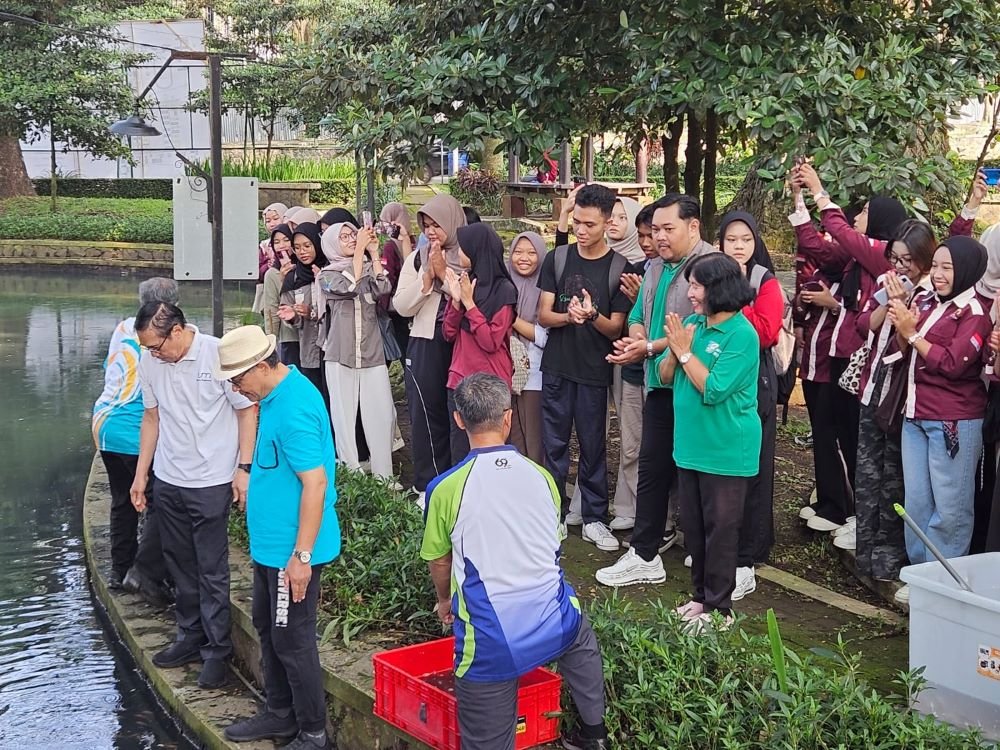
en.malanginspirasi.com – State University of Malang (UM) held “UM Cares for the Earth (UM Peduli Bumi): Preserving Nature and Greening the Campus” in commemoration of Earth Day 2026.
The entire academic community, from the rectorate, lecturers, and administrative staff to thousands of students participated in this action.
This activity was not merely an annual ceremony, but a manifestation of the campus’s philosophy of becoming a healthy and intelligent campus.
As an educational institution continuously transforming, UM recognizes that the challenges of climate change require more aggressive and measured mitigation measures.
The 2026 Earth Day celebration featured a variety of strategic activities.
They included tree planting, plant nurseries, river cleanups, and lake cleanups at UM.
Among those activitties also included tilapia and catfish release into the campus lake, paving, composting at the UM Landfill (TPST), fertilizer packaging, street garbage collection using a garbage truck, checking the condition of all equipment in the Smart Building, and optimizing the use of energy-efficient vehicles on campus.
The aim of those efforts was to create a sustainable campus ecosystem.
UM as A Pioneer in Providing Solutions to Encounter Environmental Issues
The Rector of the State University of Malang, Prof. Dr. Hariyono, M.Pd., emphasized in his briefing that superior character education must go hand in hand with an awareness of environmental protection.
He stated that the campus must be a pioneer in providing solutions to increasingly pressing global environmental issues.
“This Earth Day celebration is a moment for us to reflect on our contribution to the earth. At UM, we have strong commitment to ensuring that every inch of land and every policy adopted has an orientation toward sustainability for the future of future generations,” Prof. Hariyono emphasized.
Echoing this vision, the Head of the UM Green Campus, Prof. Dr. Prof. Sumarmi, M.Pd., explained that this year’s activities focused on strengthening green infrastructure and sustainable environmental education.
She stated that the ‘UM Cares for the Earth’ program is part of the university’s broader roadmap to achieving its Net Zero Emission target on campus.
“We’re not just planting trees, managing waste, and conserving water, but also building an integrated environmental management system. The active involvement of all campus elements in preserving biodiversity is key to UM’s continued commitment as a pioneering environmentally friendly campus in Indonesia,” said Prof. Sumarmi.
The Earth Day 2026 also involved students’ participation through educational and inspiring mass rallies.
Students Aspiration on UM Peduli Bumi
Faradilla, a representative from the UM Student Executive Board (BEM), expressed that the younger generation has a significant moral responsibility to be at the forefront of environmental protection.
“We want to prove that students are not only critical in their thinking, but also committed to action. Through this collaboration, we hope that an environmentally friendly lifestyle can become part of UM students’ daily culture, not just a fleeting trend during Earth Day celebrations,” Faradilla stated enthusiastically.
Every academic community member should really implement the spirit of UM Peduli Bumi.
By doing so, it enables them to become agents of environmental change wherever they are.
With a strong commitment and ongoing, concrete work, UM Peduli Bumi 2026 is optimistic that it can continue to be a beacon for the alignment of development of science with the preservation of the universe.
Furthermore, ‘UM Peduli Bumi’ program represents the university’s concrete efforts to support the achievement of the Sustainable Development Goals (SDGs). Strengthening environmental literacy on campus supports SDG 4 (Quality Education), where the curriculum and out-of-class activities complement each other to foster a sustainable mindset.
Additionally, tree planting and land conservation directly contribute to SDG 15 (Terrestrial Ecosystems), which aims to protect, restore, and enhance the sustainable use of terrestrial ecosystems.
This also contributes to SDG 11, namely, Sustainable Cities and Human Settlements. Another important point is the contribution to SDG 13 (Addressing Climate Change) through a systematic and massive reduction in the campus’ carbon footprint.