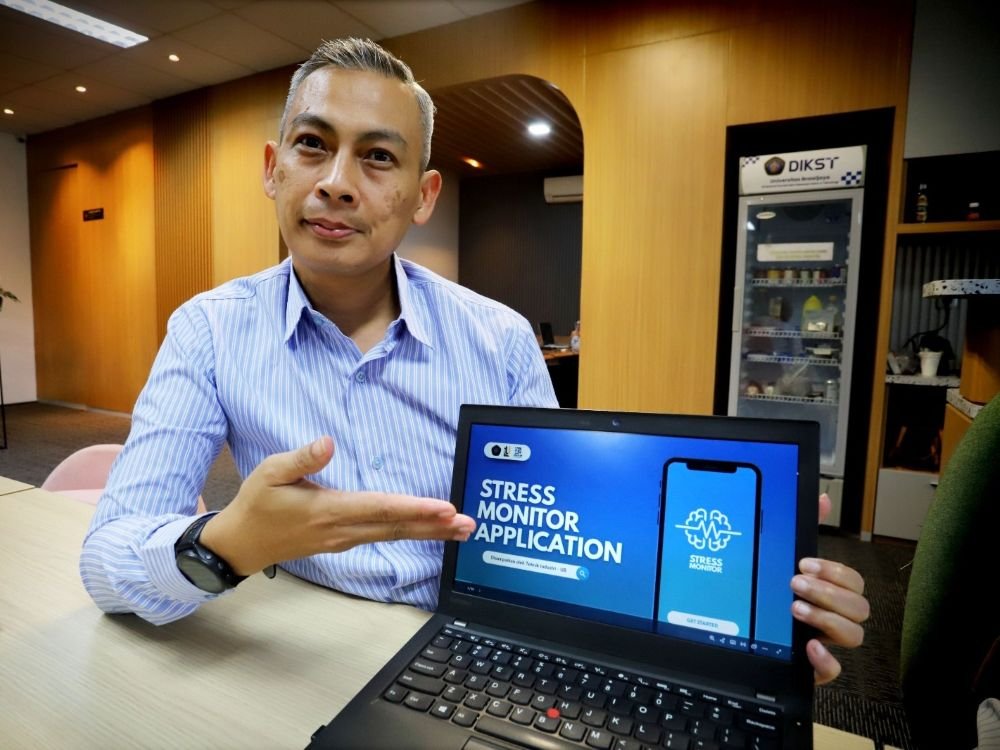
en.malanginspirasi.com – Prof. Sugiono, S.T., M.T., Ph.D., a lecturer in Industrial Engineering at the Faculty of Engineering (FT), Brawijaya University (UB), and a team of students developed Mind Matrix, a digital-based mental health detection app.
This innovation combines Heart Rate Variability (HRV) technology and digital psychological assessments to help monitor the mental health of industrial workers periodically and continuously.
Prof. Sugiono mentioned that the development of Mind Matrix stems from the importance of mental health in the workplace, particularly in labor-intensive industries.
Currently, the action of measuring workers’ mental health are generally once or twice a year.
It is inadequate to provide a comprehensive picture of their psychological condition.
Also Read:
UB Held Discussion on Draft Rector Regulation Concerning Mental Health
“A person’s mental state is dynamic and changes over time. A single measurement does not necessarily reflect their true condition, so we wanted to present a system capable of continuously profiling their mental state,” explained Prof. Sugiono.
He added that the source of a person’s mental stress does not always originate from the work environment.
Therefore, it requires an approach to assess mental health for targeting precise treatment.
“It’s possible that someone might feel comfortable at work but experience stress outside of work. This is what we want to identify so that the treatment provided is not misdirected,” he added.
How Mind Matrix Work
In its development, Mind Matrix combines two measurement methods: objective and subjective.
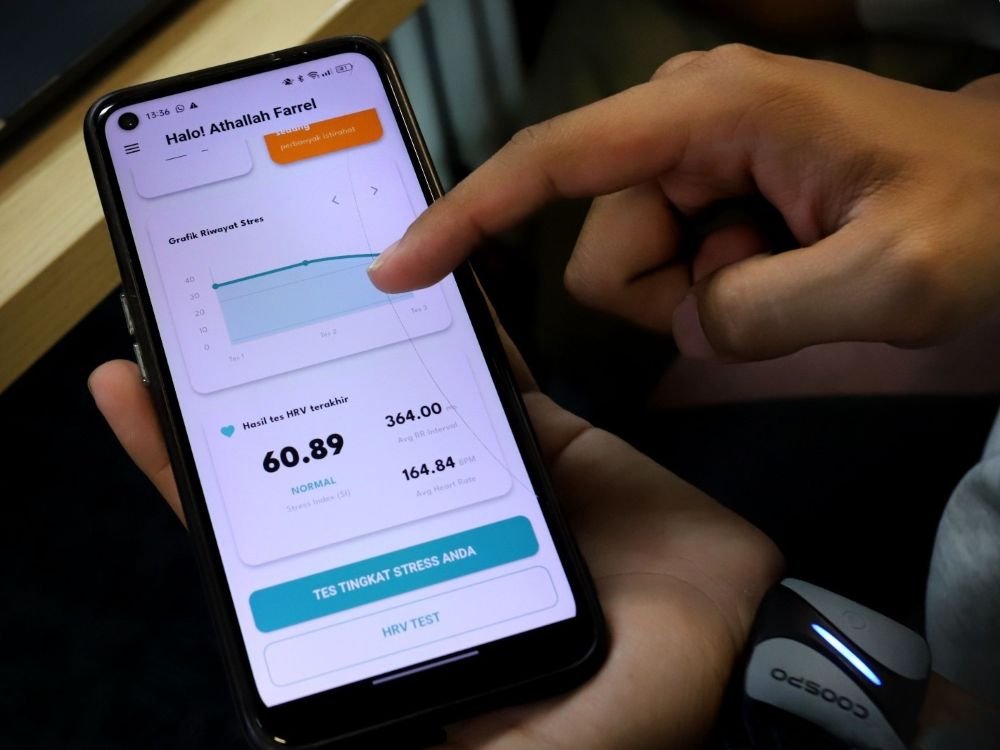
The objective measurements are using HRV technology via a wearable device to read the user’s heart rate variations as an indicator of stress.
Meanwhile, DASS DASS-42 questionnaire in the app is for subjective measurements, containing42 questions related to stress, anxiety, and depression.
Prof. Sugiono explained that the app’s system is designed to be as simple as possible for ease of use.
Users only need to wear a Cosmo smartwatch or heart rate monitor for about three minutes to take the HRV test.
Afterward, users can fill out a short questionnaire in the app regarding their daily condition.
“The HRV measurement only takes about three minutes, while the questionnaire can be completed at any time through the app. So this system can provide a more comprehensive picture of mental health,” said Prof. Sugiono.
Examples of DASS-42 Questions
Some examples of DASS-42 questions in the app include “Do you get angry easily over small things?”, “Do you have difficulty relaxing?”, “Do you sleep well?”, and “Do you feel pessimistic or sad?”. These questions are kept short and simple to understand for lay users.
After users complete the test, the app displays a mental health score along with a graph of the development of stress, anxiety, and depression.
The system store all data automatically, allowing companies to monitor employee well-being over time through a provided management website.
Currently, Mind Matrix is collaborating with PT Jatim Autocomp Indonesia (PT JAI) as an initial implementation partner.
The system has been personalized to the company’s needs and tested on a sample of employees.
Athallah Farrel Asyarif, an industrial engineering student and a member of the development team, hopes the app can be connected to more wearable devices such as the Apple Watch, Samsung, and Huawei, making it easier to use widely in the future.
AI-Based Integration for Analyzing
What’s more, the team is developing an Artificial Intelligence (AI)-based integration to help analyze HRV and DASS-42 results simultaneously.
Currently, interpreting the results still requires the assistance of a professional such as a doctor or psychologist.
“We hope that AI can help provide automatic treatment recommendations based on the collected data,” said Prof. Sugiono.
Prof. Sugiono also hopes that this innovation will not only be applicable in industrial settings, but also useful more widely in educational settings and the general public, in the future.
“If the database becomes larger and the analysis system more mature, it will certainly be possible for it to be used more widely, including in educational settings and the general public,” concluded Athallah.