en.malanginspirasi.com – The Undergraduate Mathematics Study Program, Department of Mathematics, Faculty of Science, Technology, and Mathematics (FSTeM), Universitas Brawijaya (UB), held a series of Adjunct Professor programs for the Capita Selekta Computational Science course.
This international-level activity demonstrates the university’s commitment to supporting global commitments to achieving the SDGs.
They include SDG 4 (Quality Education) through the provision of relevant lecture modules and curricula, and SDG 17 (Partnerships to Achieve the Goals) through research collaboration, technology transfer, and partnerships with international institutions.
The first Adjunct Professor program featured Dr. Mohana Sundaram Muthuvalu, an Associate Professor from Universiti Teknologi PETRONAS (UTP), Malaysia, as the keynote speaker.
Dr. Mohana, specializing in Applied Mathematics, Numerical Analysis, Numerical Linear Algebra, and Computational Science and Engineering, shared her knowledge and experience online via Zoom.
This intensive lecture took place in two sessions: Monday, June 1, 2026, and Monday, June 8, 2026, from 7:30 a.m. to 9:00 a.m. WIB.
Also Read:
FSTeM UB Introduces Innovative Student Products at the 2026 Entrepreneurship Expo and Friday Market
In the first session (June 1, 2026), Dr. Mohana delivered in-depth material on “Application of the Finite Element Method (FEM) in Thermal Analysis (Hands-on with MATLAB).”
Through this topic, students were encouraged to understand and directly practice the application of the Finite Element Method for thermal analysis using MATLAB software.
Meanwhile, in the second session (June 8, 2026), the discussion continued into the realm of medical computing with the topic “Computational Methods for Brain Tumor Growth Prediction (Hands-on with MATLAB).
It outlined computational methods for predicting brain tumor growth.
Following its success, the Undergraduate Mathematics Study Program of FSTeM UB held its second Adjunct Professor lecture, featuring world-renowned expert Prof. Dr. Sohail Nadeem from Quaid-i-Azam University, Pakistan.
This globally renowned Mathematics Professor with a Scopus H-index of 84 has extensive specializations including Fluid Mechanics, Computational Mathematics, Newtonian and Non-Newtonian Fluids, Stretching and Stagnation Flows, Boundary Layer Theory, Peristaltic Flows, Blood Flow through Arteries, and Solutions of Non-Linear Differential Equations.
This collaborative activity with experts from Pakistan was held online via Zoom in two sessions.
Session 1 took place on Monday, June 8, 2026, and Session 2 on Wednesday, June 10, 2026, both from 11:15 a.m. to 12:45 p.m. WIB.
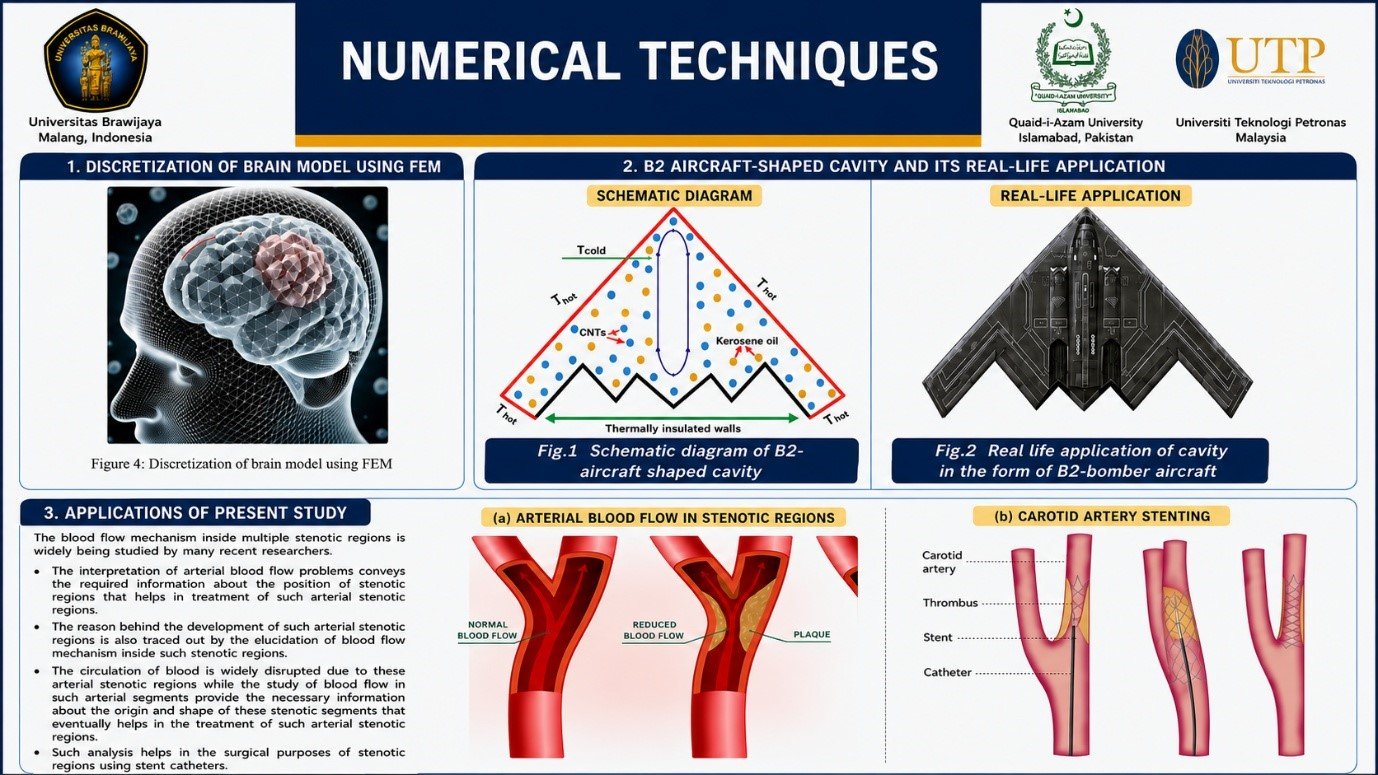
Prof. Sohail delivered the lecture material as he was focusing on the numerical solution of a bomber aircraft using the Finite Element Method, as well as the numerical solution of a blood flow model using the Finite Volume Method.
Ummu Habibah, S.Si., M.Si., Ph.D., a lecturer in the Department of Mathematics and Head of the Undergraduate Mathematics Study Program at UB’s FSTeM who acted as moderator.
She guided the entire series of Adjunct Professor lectures by these two international scientists directly.
In her statement, Ummu Habibah, Ph.D., stated that the presence of international academics such as Dr. Mohana and Prof. Sohail Nadeem was crucial for providing students with a global perspective while strengthening the university’s key performance indicators in terms of international collaboration.
“The topics presented were highly relevant to current developments in computational science. The hands-on sessions provided valuable experience for students in seeing how mathematical theory is directly applied to solve real-life problems in industry and medicine,” said Ummu.
Specifically, topics on medical analysis, such as predicting brain tumor growth by Dr. Mohana and blood flow modeling by Prof. According to Dr. Sohail Nadeem, this activity significantly contributes to SDG 3 (Healthy and Prosperous Life) through the development of innovative health technology and applied mathematics research that supports disease prevention and medical detection.
Throughout the sessions, the enthusiasm of the participants was very high.
Attending this academic activity include students from across study programs from PSSM, PSMM, and PSDM as it is also a mandatory for all students in the Computational Science Capita Selekta course.
This was evident in the numerous interactive discussions and questions posed to the speakers, particularly regarding programming challenges, fluid mechanics modeling, and the accuracy of medical computations.
Through this series of Adjunct Professor lectures, participants don’t not only gain new knowledge from international academics but also information on several international programs available for students in the fields of Mathematical Modeling and Numerical Computation.