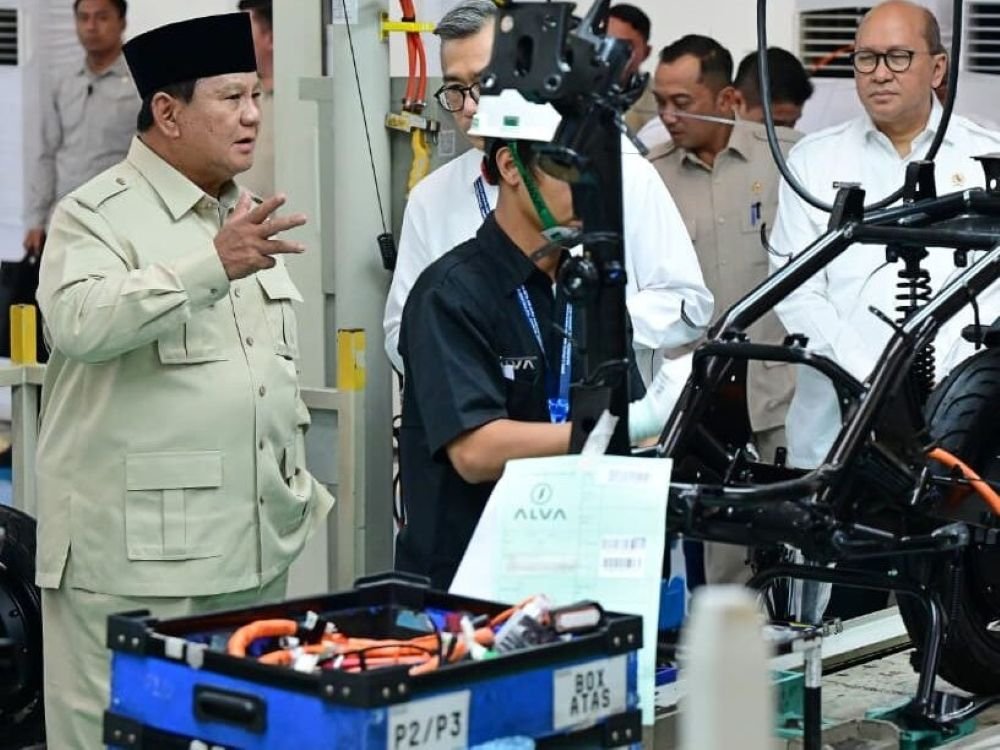
en.malanginspirasi.com – President of Indonesia Prabowo Subianto officially launched the National Electric Motorcycle (Motor Listrik Nasional – MoLiNas) and its supporting ecosystem at the ALVA Production Facility in Cikarang, Bekasi Regency, West Java, on Thursday, August 13, 2026.
The launch marks a milestone in Indonesia’s drive toward technological self-reliance, energy security, and industrial capability.
Prabowo inspected the manufacturing line and signed a commemorative plaque celebrating the milestone of 20,000 electric motorcycles produced by ALVA (under PT Indika Energy Tbk).
The government plans to introduce lower interest rates on installment payments and zero-down-payment options for the public to accelerate adoption.
Beyond two-wheelers, an electric car manufacturing complex is currently under construction at Kilometer 84 in Subang Regency, with mass production targeted by 2028 at the latest.
Praising Business Courage and Risk-Taking
Speaking to business leaders, state enterprise executives, and researchers, Prabowo commended private sector pioneers for taking bold risks to establish a domestic EV manufacturing foundation.
“Initiative requires courage because initiative carries risk. We are proud today, and we expect future progress to move even faster,” he stated as quoted from presidenri.go.id.
Drawing on a classic military motto—“Who dares, wins”—the President emphasized that industrial self-reliance cannot be achieved passively:
“Victory will not simply arrive on its own, must be fought for; it must be seized,” he continued
He challenged Indika Energy and ALVA to aim higher, promising to return when production reaches 200,000 units, and again at 2 million units.
Also read:
Meanwhile, the Minister of Investment and Downstream Industry / Head of BKPM and BPI Danantara, Rosan Roeslani, emphasized in his address that MoLiNas reflects the country’s broader vision of standing on its own feet (berdiri di atas kaki sendiri).
The effort embodies the Indonesia Incorporated model—bringing together private companies, state-owned enterprises (BUMN), academia, and government agencies to build domestic technology mastery, create local jobs, and strengthen national resilience.