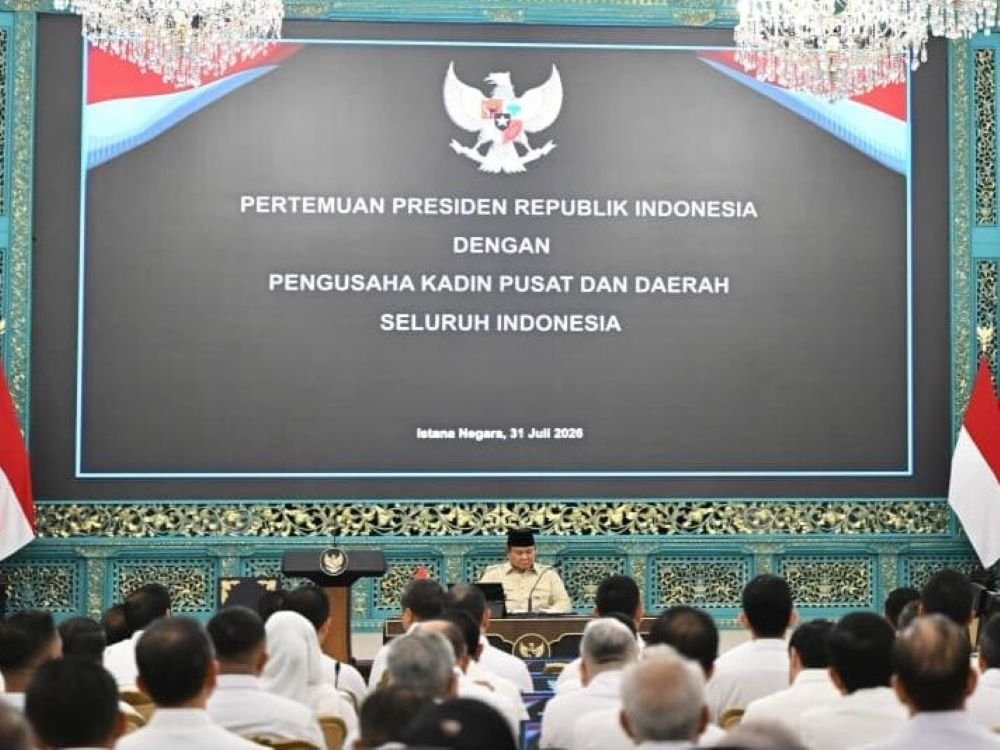
en.malanginspirasi.com — Comments of Indonesian President Prabowo Subianto about nuclear status of Iran during a meeting with business leaders at the State Palace on Friday have ignited widespread discussion.
This was due to the live broadcast of the event abruptly switched to commercials.
Speaking to members of the Indonesian Chamber of Commerce and Industry (Kadin) from across the country, Prabowo addressed escalating tensions in the Middle East.
He noted the constant stream of evening news about rising conflict.
“It is said that Iran already has nuclear weapons. Now Saudi Arabia also wants to have nuclear weapons. If Saudi Arabia wants nuclear weapons, it is not impossible that the Emirates would also want them, Qatar would also want them, and Egypt would also want nuclear weapons,” he stated.
He linked the region’s persistent instability to its abundant natural resources including oil, gas, and minerals, while describing divide and rule tactics as a living reality rather than mere historical theory, and warned of the broader risks of nuclear escalation alongside conflicts in Ukraine and the Gulf.
The sudden interruption of the live feed, which cut shortly after these remarks, prompted immediate questions on social media about the president’s sources and the sensitivity of the topic.
Clips circulated widely, with users calling for clarification from the Indonesian government and responses from the countries named.
Also Read
Gold Prices Rocket to New Record High of US$5,365 per Ounce as US-Israel-Iran Conflict Intensifies
Viral Video of President Prabowo Watching Poor Villagers Eat Sparks Outrage on X
International Assessments Differ
Prabowo’s phrasing—“it is said that”—appeared to reference circulating reports rather than an official Indonesian intelligence assessment.
Leading international bodies, including the International Atomic Energy Agency (IAEA), continue to state there is no evidence that Iran possesses nuclear weapons.
Iran maintains a stockpile of highly enriched uranium and has restricted some inspector access in recent years, raising breakout concerns, but Tehran has repeatedly denied any weapons program, citing a religious fatwa against nuclear arms.
Saudi Arabia has pursued a civilian nuclear energy partnership with the United States focused on power generation.
Analysts have long warned that any perception of an Iranian nuclear capability could accelerate interest in similar programs among Gulf states and Egypt, potentially complicating non-proliferation efforts in the region.
The UAE already operates the Barakah nuclear power plant under strict civilian safeguards, while Egypt is advancing its Russian-backed El Dabaa project.