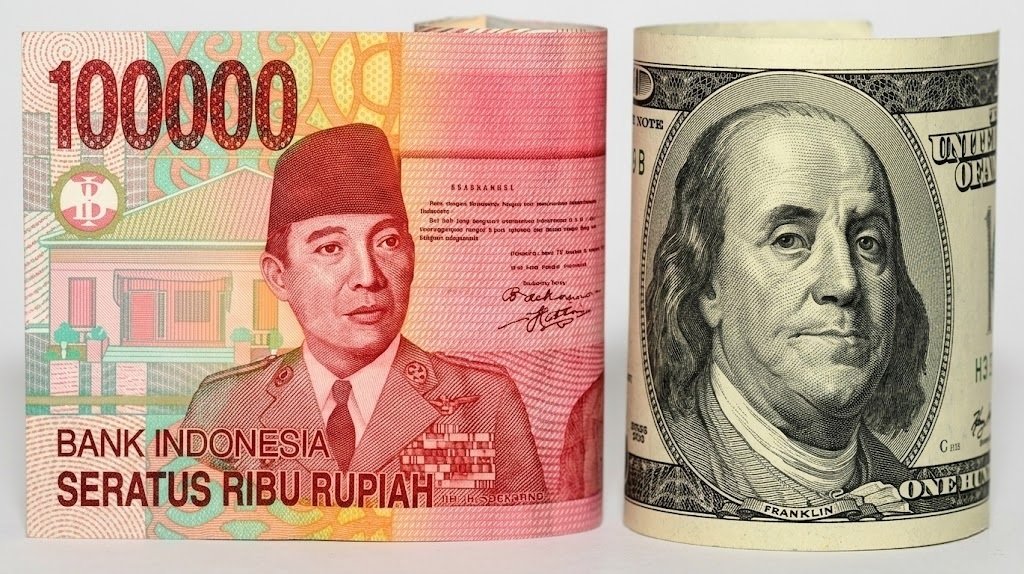
EN.malanginspirasi.com – The Indonesian Rupiah (IDR) experienced a significant depreciation against the United States Dollar (USD) during Thursday’s trading session, April 23, 2026, breaking through a new psychological barrier to record its weakest level in history. The pressure on the domestic currency stems from a combination of escalating global geopolitical tensions and the mounting burden on the State Budget (APBN) due to the spike in global oil prices.
Based on spot market trading data, the Rupiah collapsed to touch Rp17,303 per US Dollar at 10:15 a.m. Western Indonesia Time (WIB), weakening by 0.71% compared to the previous day’s close. Separate monitoring indicated that the currency had briefly traded at Rp17,315 per US Dollar, marking the lowest intraday level ever recorded.
The depreciation was widespread across various platforms and national banks. Refinitiv data noted the Rupiah opened weaker at Rp17,210, while Bloomberg data showed a level of Rp17,255 per US Dollar at the start of the session.
This condition is also reflected in the buying and selling rates at national banks, with the highest selling rate quoted by PT Bank Central Asia Tbk. (BCA) at Rp17,450 per US Dollar for TT counter transactions.
Oil Prices and Middle East Conflict
Analysts assess that the Rupiah’s current depreciation cannot be separated from the heating situation in the Middle East. Tensions between the US-Israel axis and Iran have escalated once again following failed negotiations and reciprocal ship seizures in the strategic waters of the Strait of Hormuz. This condition has kept the US Dollar Index (DXY) in a strengthening zone as market participants flock to safe-haven assets.
This escalation has had a direct impact on the soaring price of global crude oil. Brent crude oil prices have now touched US$103 per barrel, far exceeding the 2026 State Budget assumption which set the oil price at around US$70 per barrel with a ceiling of US$92.
“The pressure on the Rupiah comes from a combination of external and domestic sentiment, both of which are equally strong. This increase in energy prices puts additional pressure on import-dependent countries like Indonesia,” said Currency Analyst Ibrahim Assuaibi.
The spike in oil prices is projected to widen the budget deficit as Indonesia remains dependent on imports of approximately 1.5 million barrels of oil per day. The burden of energy subsidies is also ballooning amid the government’s policy to hold subsidized fuel prices steady.
Read Also:
Indonesia Weighs Nationwide WFH Revival to Cut Fuel Use as Global Oil Risks Mount
Domestically, Bank Indonesia’s (BI) decision to hold the benchmark interest rate at 4.75% during this month’s Board of Governors Meeting (RDG) is deemed insufficient to withstand the rising external pressures.
BI Governor Perry Warjiyo stated that the central bank is continuously striving to maintain Rupiah stability, one of which is by lowering the threshold for purchasing foreign currency in cash from US$100,000 to US$50,000 per person per month.
“We are confident that going forward it will be more effective; spot purchase transactions must have an underlying basis. Previously, 89.2% of spot transactions had an underlying; now it’s 93.5%,” Perry explained.
BI Deputy Governor Thomas Djiwandono claimed that this policy has begun to show results, with a decrease in the daily average of customer spot transactions from US$78 million to US$60 million since April 17, 2026.
Outlook: Rupiah Potentially Heading to Rp17,400
With external fundamentals still unconducive, analysts predict that the pressure on the Rupiah will continue. Ibrahim Assuaibi even projects that the weakening could continue to touch the Rp17,400 per US Dollar level by the end of April 2026, sooner than initial expectations which had pegged that level for later in 2026.
Meanwhile, Doo Financial Futures Analyst Lukman Leong projects that the Rupiah’s movement today will be in the range of Rp17,150 to Rp17,300 per US Dollar. This aligns with the weakening of other Asian currencies such as the Malaysian Ringgit, Philippine Peso, and Thai Baht, which also corrected this morning.